1. BIOGRAPHICAL DATA & CONTACTS
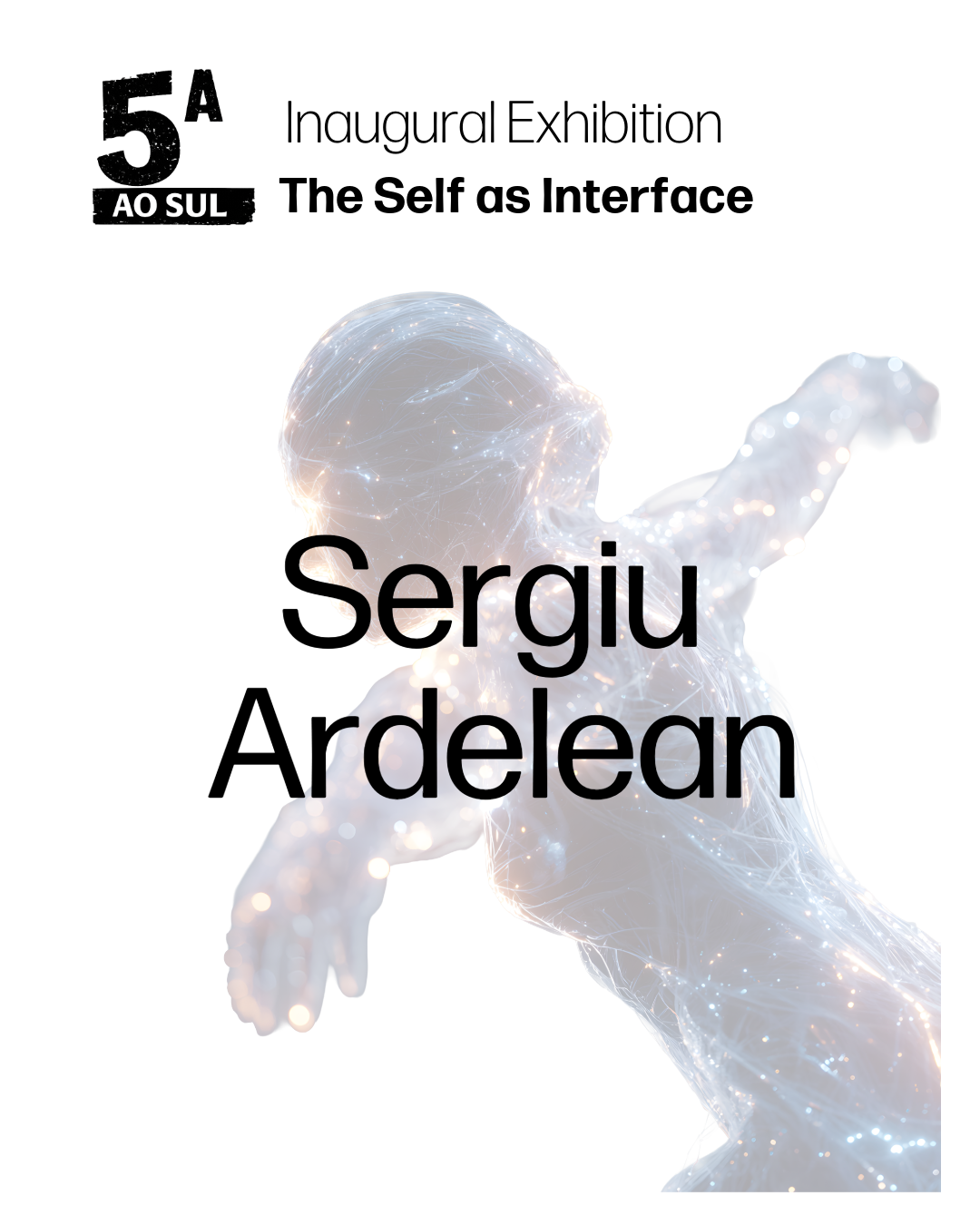
Full Name: Sergiu Ardelean
Artist Name: Sergiu Ardelean
Nationality: Romanian
Country of Residence: Romania
Website: sergiuardelean.ro
Social Media (Instagram):
https://www.instagram.com/sergiu.ardelean.visual.artist/
Artist Name: Sergiu Ardelean
Nationality: Romanian
Country of Residence: Romania
Website: sergiuardelean.ro
Social Media (Instagram):
https://www.instagram.com/sergiu.ardelean.visual.artist/
2. ARTISTIC CAREER & ARTISTIC STATEMENT
Short Bio / Artistic Career:
Sergiu Ardelean works with light as a primary material, as a medium for shaping perception and aesthetics that govern the visual experience.
He has over twenty-five years of lighting design for stage, television and film, but especially for the public. He organically manifests his interest in exploring the universe of installations and the fine line between light, form, data and digital identity, fascinated by the creative force of visual art.
Artistic Statement:
Light fascinates me. I use it as a primary material. Over more than twenty-five years of lighting design for the stage, for television, for the cameras, but above all for the audience, manipulating photons has become my second nature.
What fascinates me continuously is light's power to alter perception: not a tool that reveals objects or creates moods, but a living substance, a presence with will, temperament, and body. Video, to me, is also light, charged with abstract data, a layer of information I work with as material.
In my works I aim to mix light, video, and data in sculptural and sensory form, on the thin line between representation and experience. I imagine they exist in several simultaneous visual states that collapse into one through observation or through the participation of the viewer, who brings the state into existence. Each work asks how much of what we call real is, in fact, organised light, caught in the very moment it becomes visible.
GENERAL CONTEXT AND PRACTICE
1. With over twenty-five years of professional experience in lighting design for stage, television, film, and public venues, how does this extensive background in shaping physical space through light inform your transition into interactive installation art?
One useful skill I use from the back experience is to guide the user to see exactly what I want to show. I can manipulate attention thru light, framing and space placement.
One useful skill I use from the back experience is to guide the user to see exactly what I want to show. I can manipulate attention thru light, framing and space placement.
2. You are currently pursuing an MA in Interactive Technologies for Performing and Media Arts at UNATC in Bucharest. How has this academic immersion shifted your understanding of the relationship between data, light, form, and digital identity?
I was already used to technology, systems integration, networks set-up, visualisation software, end-user programming on specialised lighting software. And as DoP / LD (Director of Photography / Lighting Designer) I am used having my team doing all that. I enjoy many times working side by side with them. But coding is a different kind of thing. I only remember that form high school days. I never dived „under the hood”. But now at this MA, I have a course named „Creative Coding” which opened a new world for me. Now I understand better the coding language that drives the humanity’s digital future. That is why, coming from an analog age, I have witnessed the transition and I love connecting the dots for understanding where we are going, by remembering where we came from. Form, light, data, analog and digital identity are all linked in ways for more tangled than we realise.
REGARDING THE ARTWORK "ANIMA HIBRIS" (2026)
1. You state that contemporary hubris is no longer an individual transgression, but the unconscious condition of a whole civilisation in accelerated ascent. How does "Anima Hibris" map this societal condition onto the myth of Icarus?
When you have too much power, you upset the spoken and unspoken laws in effect at a time being. It is our nature. In this modern times and age we explore the fabric of our universe, and we are moving fast. Many unknowns yet. The world is united in technological advancement and whatever the builders or users, we are sharing the same appetite for innovations. We are all responsible for our future. Our current world economy is based on „consumerism”, and this spirals uncontrollable as users demand, and manufactures deliver. We are all together in this as we are intrinsically linked by world trade. We must be careful, as we are getting more and more confident in our abilities to control the laws of the universe. They might be turning on us at some point …
2. The life-sized figure is sculpted out of galvanized steel wire, frozen right before flight. What led you to choose the industrial, tangled quality of steel wire to represent the modern human form?
Modern is defined by the use and level of technology. I wanted to create a hard contrast between analog and digital. Thru the life size I want the viewer to relate. To understand I am talking about us, the humans. The tangled steel hints that we are imperfect, the shape is there, but is not uniform. It is like a tridimensional sketch, see the form that shows us the humans, not the individual, because I am talking about all of us. Steel is the layout of power in ancient times, digital is the modern power, and we always ready to fly.
3. The plexiglas and tracing paper wings layer C++ code classes, physics equations, and Latin words alternating between virtues and vices. What is the symbolic link between the rigidity of computer logic (C++) and the classical moral vocabulary of the Latin language?
Light carry the data. It is there from the begging of our time and we are just stating to understand it. We use, manipulate it, but is it has far more meaning inside of it. The wings displays a shifting vocabulary of C++ code classes, physics equations, and Latin words: virtues and vices in alternation. The tech language resolves into the spoken language on the backdrop of theoretical research. I tried to create an unlikely concept that fuses completely different ways we see, explore, discover and invent our world.
Light carry the data. It is there from the begging of our time and we are just stating to understand it. We use, manipulate it, but is it has far more meaning inside of it. The wings displays a shifting vocabulary of C++ code classes, physics equations, and Latin words: virtues and vices in alternation. The tech language resolves into the spoken language on the backdrop of theoretical research. I tried to create an unlikely concept that fuses completely different ways we see, explore, discover and invent our world.
4. The installation uses 360-degree proximity sensors to detect the viewer's approach, triggering an intensified projection and a pulsing mirrored heart. How does making the viewer's body the direct catalyst of the artwork's acceleration amplify the concept of "unconscious complicity”?
The real world showed it works best only at 180 degrees. Due to space and logistics, the visitors approach the front side. The installation runs a first state, the stand-by state until it detects a visitor on proximity, then it enters the second state, running the positive/negative language. The user has entered into relation whiteout realisation. The wings language talk about him as a representative of all of us. Then if he decide he can touch the wireframe and establish a connection, and the beating heart points that we are still human.
5. You note that "the viewer does not observe Icarus – they become Icarus." How does the use of light reflection and spatial immersion collapse the distance between the spectator and the mythological figure?
Contemplating the visual positive/neagative content one might realise that it is us. The proximity, the interaction, triggered a response: the second running state. Already there is the third-state, inside, waiting to be revealed. And if the user chooses to, it will be shown, so the reality in the wing changes by choice of interaction, pointing to our true nature we don’t realise, recognise or unaware of. Light is shaped by color, white and red for a chromatic dramaturgic visual. In the darkness of the room, the wireframe is dimly lit, so the intensity of white and red light have a visual impact.
6. In your submission notes, you mentioned that this interactive installation has the potential to be transformed into a full digital video art piece. Can you elaborate on how you envision this conceptual transition? How would the removal of physical, sensor-driven proximity alter the viewer's role as the system's activator?
The click we take for granted is the most powerful tools in our arsenal. In the digital world the one and only line of defence is the click. With the help of technology, the click became the touch. I am creating a interactive widget, keeping the wings shape, to navigate the three states of visual content, but this time is it fully conscious. You must asume and click for each state, to reveal the content. The logic of click, and return to state remains. First state is stand-by. Click to go the second state, which runs the positive/negative content. And finally click again to enter the hibris states which returns to second state after five seconds.
INTERSECTION WITH THE THEME: "THE SELF AS INTERFACE”
1. In "Anima Hibris," the human body acts as a literal interface — a physical site where historical morality, digital code, and real-time sensory data collide. In your opinion, has the modern human self completely transformed into an interactive dashboard for external systems?
Is it exactly what this installation is meant to show. Digital is taking over more and more. For now we are drawn to the mobile gadgets, and if it all goes the same way, it is only a matter of time for us to be fully immersed into the digital realm. I am trying to convey a message of cautionary tale. These days, beyond the technological pride as humanity, we are way to proud to admit we are wrong. And this could be dangerous because it could blind us to see our downfall of real emotions, human connection and interaction. The bond between physical and digital is stronger than we think, and it is up to each one of us to consider how much we allow to be used by external systems rather than use them.
2. Your work functions passively-actively, requiring no conscious intent from the user other than their physical proximity. How does this challenge the traditional concept of interactivity in media arts, where explicit input is typically expected from the user?
It is a true challenge ! The installation has three states: the stand-by state which runs when no one is close to, the second state which activates on proximity, and the third state which is the interaction that triggers a response. And here lays the trick: people, most of them at least, know no to touch an art piece. But I DO want them to touch it. Some do some don’t. I am working now to add a visible marker and the chest, to encourage the hand placement. Not everyone is bold to break the rules (as the story goes), so I must give them a gentle push.
3. As Galeria 5ª ao Sul provides a hybrid environment for contemporary post-digital art, how do you see the dialogue between the physical scale of your steel installation and the virtual layers of code and light operating within this space?
It is a challenge. The visual part is self-contained and it might work well as stand-alone, but I hope it will also spark curiosity and interest to experience the real-world installation as intended. I created an interactive widget for the online users to interact with, and see all the visual layers, but they must bear in mind that, as in life, we must go out the experiment the real thing.