1. Biographical Data & Contacts
Full name: Brad Rumble
Artist name: Brad Rumbl
Nationality: British
Country of Residence: UK Website; www.rumblart.com
Social media: IG @bradrumbl
Full name: Brad Rumble
Artist name: Brad Rumbl
Nationality: British
Country of Residence: UK Website; www.rumblart.com
Social media: IG @bradrumbl
2. Artistic Career and Artist Statement
Short Bio / Artistic Career:
Brad Rumbl is a multidisciplinary artist working across digital sculpture, installation, and immersive technologies, based in the UK. He holds a First Class Honours BA in Fine Art and a Creative Computing Level 5 Diploma from Norwich University of the Arts, and has since developed his practice through interdisciplinary AI/XR research residencies including Electric Dreaming with BRiGHTBLACK at Cambridge's Leverhulme Centre for the Future of Intelligence and Liverpool John Moores University. His work has been supported by a Developing Your Creative Practice grant from Arts Council England, and is currently partnered with the Centre for Consciousness Science in the UK. Alongside his studio practice, he speaks and writes regularly on neurodiversity, mental health, and digital art, including contributions to the Reach Out for Mental Health podcast and the Neurodiversity and Digital Art Symposium.
Artistic Statement:
I am a multidisciplinary artist working across digital sculpture, installation, and immersive technologies to investigate the architecture of consciousness as a structured, knowable system. My practice uses non-AI computation, geometry, and embodied form to externalise the internal mechanisms through which experience, meaning, and selfhood emerge, developing works that function as research instruments rather than representations, inviting viewers to encounter the underlying structures through which the self is built and rebuilt.
GENERAL CONTEXT AND PRACTICE
1. Your background bridges Fine Art with Creative Computing (Norwich University of the Arts) and interdisciplinary AI/XR research across Cambridge and Liverpool. How does your technical expertise in digital technologies intersect with your exploration of altered states, neurodiversity, and psychological healing?
My technical expertise is in 3D software and coding. I came to it later than you might expect, I grew up working in traditional media, clay, paper, paint, and only got my first computer at 15, once I had a part time job and could afford one myself, coming from a poor background. The shift to digital happened around five years ago, when the altered states that accompanied my healing began revealing images to me that I had no way of translating for others through traditional media. Those visions were too vast and materially impossible to realise physically, a single point of light representing consciousness, for instance, could only exist physically as an LED or bulb, which would undercut the very thing it's meant to signify. Digital tools let me capture that scale and detail, light, depth, the texture of scratched gold, without those compromises. There's also a conceptual fit, if the work is about consciousness as something structured and almost algorithmic, it makes sense that its material is literally built from algebraic matrices and vertices. And there's a healing dimension to the process itself. I can follow an idea as it arises, rather than being slowed or priced out by physical fabrication, which matters when the visions I'm working from are large and demand to be met at scale.
My technical expertise is in 3D software and coding. I came to it later than you might expect, I grew up working in traditional media, clay, paper, paint, and only got my first computer at 15, once I had a part time job and could afford one myself, coming from a poor background. The shift to digital happened around five years ago, when the altered states that accompanied my healing began revealing images to me that I had no way of translating for others through traditional media. Those visions were too vast and materially impossible to realise physically, a single point of light representing consciousness, for instance, could only exist physically as an LED or bulb, which would undercut the very thing it's meant to signify. Digital tools let me capture that scale and detail, light, depth, the texture of scratched gold, without those compromises. There's also a conceptual fit, if the work is about consciousness as something structured and almost algorithmic, it makes sense that its material is literally built from algebraic matrices and vertices. And there's a healing dimension to the process itself. I can follow an idea as it arises, rather than being slowed or priced out by physical fabrication, which matters when the visions I'm working from are large and demand to be met at scale.
2. You frequently describe your digital sculptures as "Core Devices" that capture consciousness at a given moment in time. How do you view digital software as a medium for translating complex, non-linear internal realities into tangible visual structures?
The term Core Device came from recognising that human behaviour follows a relatively universal algorithm, developing in stages, much like the cogs inside a wristwatch that allow time to be read. We develop through a balance of internal and external locus of control, and what separates us as individuals is really only the surface level of what affects that inner device, the root of our core belief system, which in turn shapes identity. The mind's relationship to any given stimulus is deeply non-linear, it draws on memory and imagines new scenarios from a single data point. Digital media can do the same thing. It lets me take snapshots of a work as it develops, where each stage could stand as an artwork in its own right. Certain imagery and approaches recur across the series, much as a single moment of enlightenment or trauma can redirect the whole trajectory of who we become, for better or worse. Digital software also introduces time into the work itself, the mandala-like structures are always shifting, layers growing or shrinking, echoing how we might build emotional strength and heal, or how difficult periods can temporarily bury the more luminous parts of ourselves.
REGARDING THE ARTWORKS
1. In "Staring Through the Fire Watching My Friends Become Gods" (2025), you explore consciousness emerging through layers during an altered state, invoking Jungian archetypes. How does the intricate, mandalic geometry of your digital sculpture reflect the psychological process of self-actualization?
Self actualisation, for me, is about observing the layers of our own development objectively, which is exactly what the mandala, and the Zen Buddhist Enso, allow. The Enso captures the self at a moment in time, it is always a circle, yet no two are ever drawn identically, each carries small variations that speak to who we are in that instant. Having worked within the mental health system, I began recognising recurring patterns in the people I supported, and started making mandalas of my own as a way of giving those patterns form, well before I knew of Jung's own practice. Discovering later that Jung had independently arrived at mandala making as a way of exploring and actualising his own psyche, and used that self knowledge to better understand and support his patients, felt less like an influence and more like confirmation, it pointed to the kind of collective consciousness Jung wrote about, and which is also present in Hindu thought, the idea that certain forms and patterns of self understanding surface independently across people and cultures because they are shared at a deeper level.
The geometry in these works is also built on the symbolic meanings assigned to numbers in sacred geometry, which I use as a structure for thinking about the self. I start from 0, the substrate that precedes the self, comparable to how a coded sequence begins at 0, or a blank canvas, an untouched instrument, the society or genetic code we're born into. From that substrate, 1 emerges as the single point, the same point of light that begins each Core Device, drawn out into a circle to represent the emergence of both an inner self and an outer, perceived self. Each further number in the mandala carries its own meaning, building outward toward a wider sense of connection with the world beyond the self.
The geometry in these works is also built on the symbolic meanings assigned to numbers in sacred geometry, which I use as a structure for thinking about the self. I start from 0, the substrate that precedes the self, comparable to how a coded sequence begins at 0, or a blank canvas, an untouched instrument, the society or genetic code we're born into. From that substrate, 1 emerges as the single point, the same point of light that begins each Core Device, drawn out into a circle to represent the emergence of both an inner self and an outer, perceived self. Each further number in the mandala carries its own meaning, building outward toward a wider sense of connection with the world beyond the self.
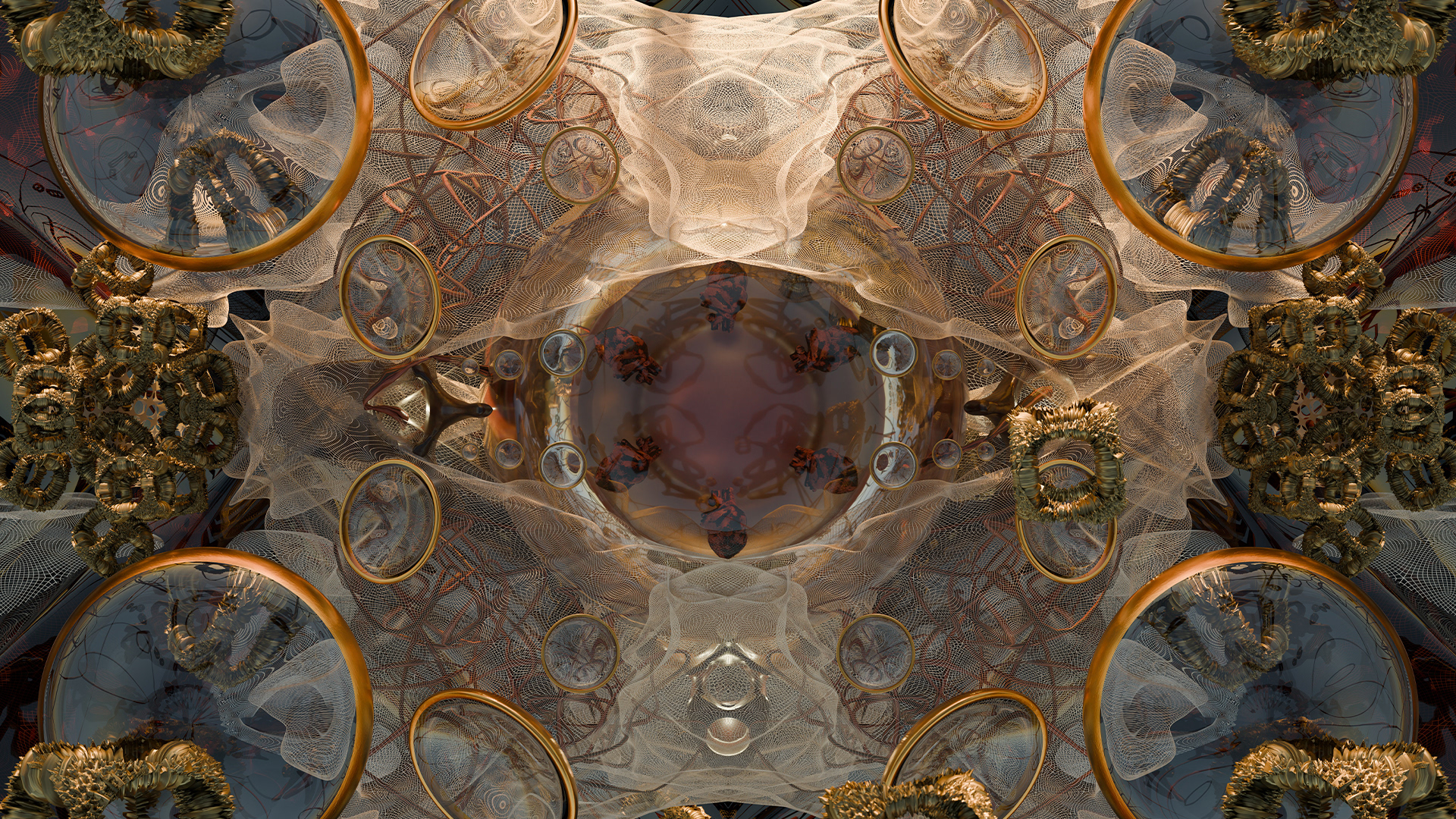
2. In "The Net Was Cast And The Chest Was Caught" (2025), you process the trauma of narcissistic abuse and panic attacks, depicting a caged heart surrounded by web-like structures and an external eye. How does creating this dense digital architecture serve as a mechanism for reclaiming internal agency and processing psychological strain?
The internal agency here comes from the act of making itself. I've always found the process therapeutic, the flow state lets images reveal themselves to me as a way of processing what I've been through. Taking the terrifying, impending doom feeling of a panic attack, or the experience of abuse, and transmuting it into an artwork I consider close to divine and layered with meaning, is itself the act of overcoming that emotion. The finished image becomes an artefact reminding me that emotions and events are only ever a moment in time, and that they pass, but only if I actively work through them rather than let them settle into background noise. If I let something become background noise, I lose awareness of how it might resurface later. Making an artefact of the moment means I can look at it, remember what happened, and stay conscious of where I actually stand on it, should it come up again. There's also something beautiful in taking a painful memory and turning it into something that looks beautiful, rather than tormented or horrific.
3. The use of gold rims around the magnifying elements in "The Net Was Cast..." symbolizes finding value and healing within trauma. How do you balance raw emotional vulnerability with polished digital aestheticism in your work?
diminish vulnerability in its male population, showing it became an act of rebellion against the status quo, and I could see the alternative, that suppression manifesting as anger and toxic masculinity, long before those terms entered common use. The aestheticism in the work is a celebration of the parts of myself others might find too raw to reveal. I've learned that for people to show they care, which I think almost all humans are capable of, and which to me defines humanity, someone first has to reveal that they might need care in that moment. So the raw emotion itself is beautiful, it shows us what we value, what we want to change, what we want to hold onto. The gold rims, and the series as a whole, are a reflection of that beauty in vulnerability once it's freed from shame or from seeing ourselves as weaker for having it.
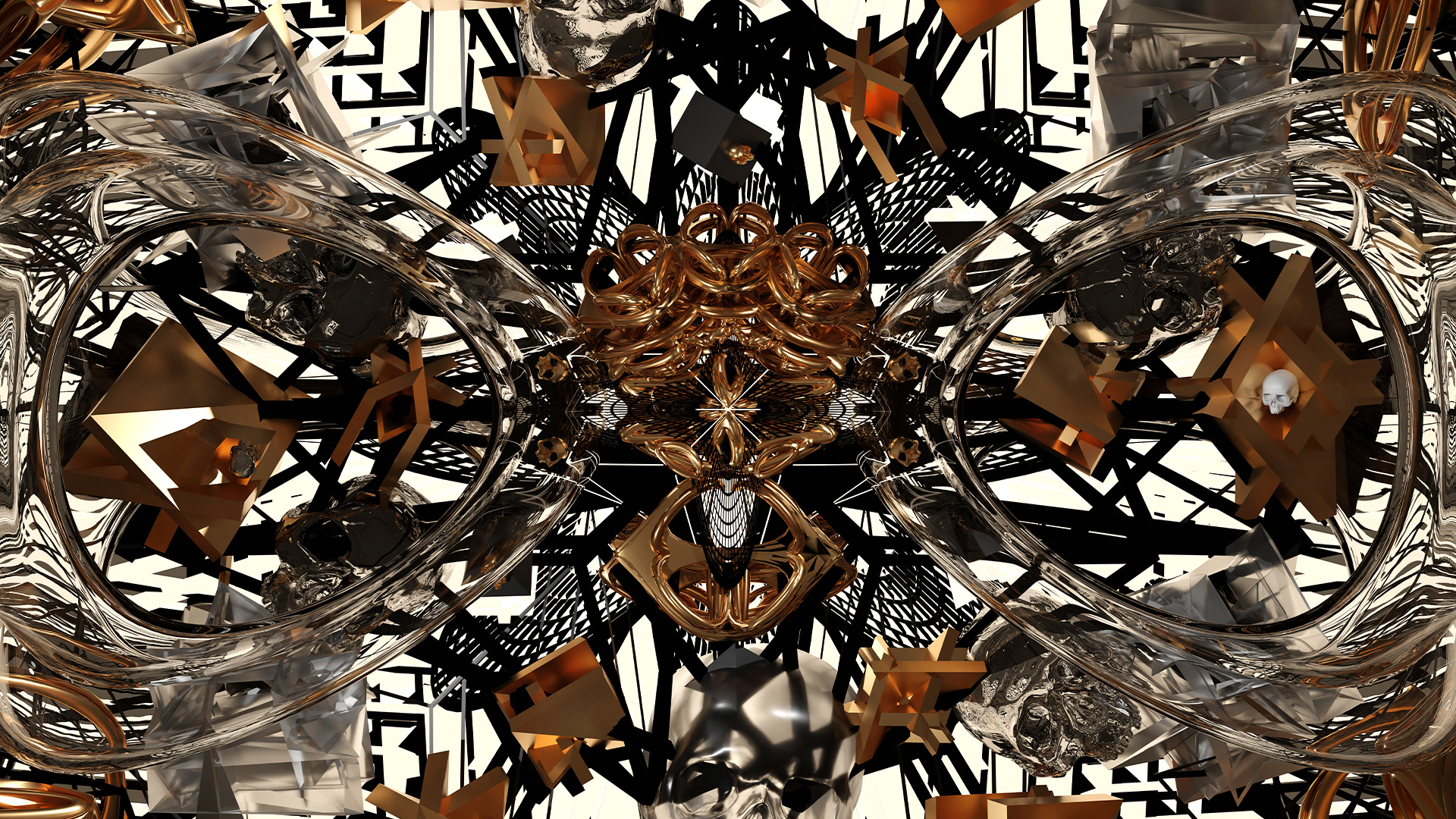
4. "Sitting and Waiting For Teacher" (2021) references closed-eye visual phenomena, psychedelic experiences, and hidden memento mori elements (skulls). How does this early foundational piece inform the evolution of your "Core Device" series?
Sitting and Waiting For Teacher' was the second or third piece where the pattern that defines the Core Device series began to emerge, layering objects to represent the psyche, a naming convention, a hidden point of light standing for consciousness or soul, and modifier stacks (edge split, displace, decimate) that speak to specific aspects of growing from childhood into adulthood. The closed eye visuals that I translated into the piece came directly from psychedelic experience, which let me revisit my own development from an embodied place, feeling how those moments had registered in the body, and, through the neuroplasticity that psychedelics can open up, reshape those memories into an understanding of why they mattered to who I became. The hidden skulls carry that further, coming from a working class background where there was little space for philosophical reflection, confronting death as inevitable let me live in and appreciate the present moment more fully. The title is a tongue in cheek nod to waiting to be handed answers rather than actively seeking them. That period of psychedelic use lasted only two years, but it planted the seeds for the life's work that followed, using largely non-representational form to share the depth of human experience, since direct representation risked narrowing its universality.
INTERSECTION WITH THE THEME: "THE SELF AS INTERFACE"
1. Your submitted works present the human subconscious—trauma, altered states, and spiritual introspection —as a complex, layered geometric interface. Within the framework of "The Self as Interface," do you consider the digital screen to be a window into internal consciousness or a mirror reflecting external mediation?
I consider the screen a window into internal consciousness rather than a mirror of external mediation, and the rise of AI makes that clearer to me, not less. Computers run on a binary system, on and off. In us, the equivalent switch isn't on/off but danger/safety: will this bring safety or put me at risk? Fire can warm us or burn us, a dog can protect us or attack us, food can nourish us or poison us, a person can love us or abuse us. We read all of this instinctively, in service of survival and, further up, of meeting something like Maslow's hierarchy of needs. Over time that deep switching pattern becomes the programming behind what we call the self, our identity, and it's also what drives us to oppose those who read as belonging to an 'opposite' identity structure: old versus young, left versus right, rich versus poor. If we can understand the switches inside a machine, we're better placed to understand the switches inside ourselves, and to choose consciously whether we want to keep running on their defaults. Do I want to believe the world is terrible or amazing? Am I a good person or a bad one? These questions feel subjective, but underneath them sits the same binary structure. AI trained on reward and punishment models isn't so different, reward there maps to what registers for us as joy, belonging, or meaning, punishment to what registers as pain. The machine doesn't have a will to survive or thrive behind it, but it still reflects the architecture we run on, which is exactly why the screen functions as a window inward rather than a mirror pointing back out at the world
2. When presenting these intricate digital sculptures within Galeria 5ª ao Sul's virtual 3D gallery environment, how do you expect the viewer's spatial navigation to interact with the multi-layered depth of your visual mandalas?
At present these works exist as large format prints rather than fully realised 3D environments, though building out full VR versions of them is something I'd like to develop in future. When mounted physically, I position the central eye of each piece at eye level with the viewer, and I've deliberately worked at scale rather than keeping the pieces small, drawing on Edmund Burke's idea of the sublime, where scale itself can overwhelm and move a viewer before they've consciously processed what they're looking at. I've seen that response firsthand, gasps, tears, people recognising something of themselves in the piece before they can articulate why. Within Galeria 5ª ao Sul's virtual gallery, I'd expect proximity to do similar work. As a viewer moves closer, finer details, the etched textures, the hidden elements tucked into the geometry, only become visible on close inspection, so navigating the space becomes a kind of active looking, a viewer chooses how deep into the piece they want to go, rather than taking in everything at once from a distance. That mirrors the works themselves, what's visible at a glance is only the surface layer of something much more layered underneath. I always aim for my work to inspire contemplation within the viewer, the aesthetic of the pieces alone do not reveal the nuanced layers of meaning within them, leaving the viewer to contemplate their own meaning when viewing the piece alongside its title. If they wish to know the depths of its meaning they are always free to engage in the same curiosity I follow to create my own meaning too.