Artist Name: HeresAndHolti
Nationality: Dutch
Country of Residence: the Netherlands
Website: https://www.heresandholti.com
Social Media (Instagram / Others): insta @heresandholti @zeefluweel
Short Bio
HeresAndHolti is a Dutch interdisciplinary artist duo working across installation, experimental moving image, artificial intelligence, virtual reality, and immersive storytelling. Their work explores identity, belonging, exclusion, and the invisible systems that shape human behaviour. Combining satire, symbolism, and poetic storytelling, they examine how technology, institutions, and collective beliefs influence the way we perceive ourselves and others.Their work has been presented internationally at exhibitions and festivals dedicated to immersive art, experimental moving image, and digital culture, including Circular ArtSpace (VR), Cista Arts (UK), Suture Zone (Canada), and Large Scale Paintings Magazine.
HeresAndHolti is a Dutch interdisciplinary artist duo working across installation, experimental moving image, artificial intelligence, virtual reality, and immersive storytelling. Their work explores identity, belonging, exclusion, and the invisible systems that shape human behaviour. Combining satire, symbolism, and poetic storytelling, they examine how technology, institutions, and collective beliefs influence the way we perceive ourselves and others.Their work has been presented internationally at exhibitions and festivals dedicated to immersive art, experimental moving image, and digital culture, including Circular ArtSpace (VR), Cista Arts (UK), Suture Zone (Canada), and Large Scale Paintings Magazine.
Artists statement
Our work explores what it means to be human in an increasingly mediated world. Through installation, experimental moving image, artificial intelligence, virtual reality, and immersive storytelling, we investigate how identity is shaped by systems of belief, technology, institutions, and collective behaviour.
Rather than treating AI as either a threat or a solution, we use it as a mirror that reveals human desires, fears, prejudices, and the universal longing to belong. Our works unfold as contemporary fables, combining satire, symbolism, and recurring fictional protagonists to expose the invisible mechanisms that shape our lives.
We believe art should create space for both empathy and critical reflection. By inviting viewers into poetic yet unsettling worlds, we encourage them to question not only the systems surrounding them, but also their own role within them. Ultimately, our work is not about technology itself, but about humanity—and what happens when the interface begins to define the self instead of merely representing it.
Our work explores what it means to be human in an increasingly mediated world. Through installation, experimental moving image, artificial intelligence, virtual reality, and immersive storytelling, we investigate how identity is shaped by systems of belief, technology, institutions, and collective behaviour.
Rather than treating AI as either a threat or a solution, we use it as a mirror that reveals human desires, fears, prejudices, and the universal longing to belong. Our works unfold as contemporary fables, combining satire, symbolism, and recurring fictional protagonists to expose the invisible mechanisms that shape our lives.
We believe art should create space for both empathy and critical reflection. By inviting viewers into poetic yet unsettling worlds, we encourage them to question not only the systems surrounding them, but also their own role within them. Ultimately, our work is not about technology itself, but about humanity—and what happens when the interface begins to define the self instead of merely representing it.
GENERAL CONTEXT AND PRACTICE
1. As an interdisciplinary artist duo, you navigate the intersection of AI, VR, video art, and immersive storytelling. How does working as a collaborative unit alter or enhance the exploration of individual identity and 'the self' within digital environments?
Working as an artist duo constantly reminds us that identity is never created in isolation. Every project evolves through dialogue, different perspectives, and shared decision-making. This process reflects the digital world itself, where identity is continuously shaped through interaction with people, technologies, and social systems. Rather than seeing “the self” as fixed, we understand it as something fluid and relational. Our collaboration is therefore more than a way of working—it embodies one of the central ideas in our practice: that identity is always formed through connection, negotiation, and exchange.
2. Your practice heavily integrates artificial intelligence and digital narratives. Do you view AI as an external tool used to mirror human behavior, or does it function as an independent interface that actively reshapes our understanding of what it means to be human?
We primarily see AI as a mirror of human behaviour. It reflects our desires, fears, prejudices, and aspirations by drawing from the vast archive of images and ideas we have created. At the same time, AI-generated content increasingly influences how we perceive ourselves and others. In that sense, AI becomes an interface that participates in shaping identity. Our work explores this tension. We are less interested in the technology itself than in the human responses it provokes.
REGARDING THE ARTWORK "ZEEFLUWEEL IN THE LAND OF THE PERFECT BODIES" (2026)
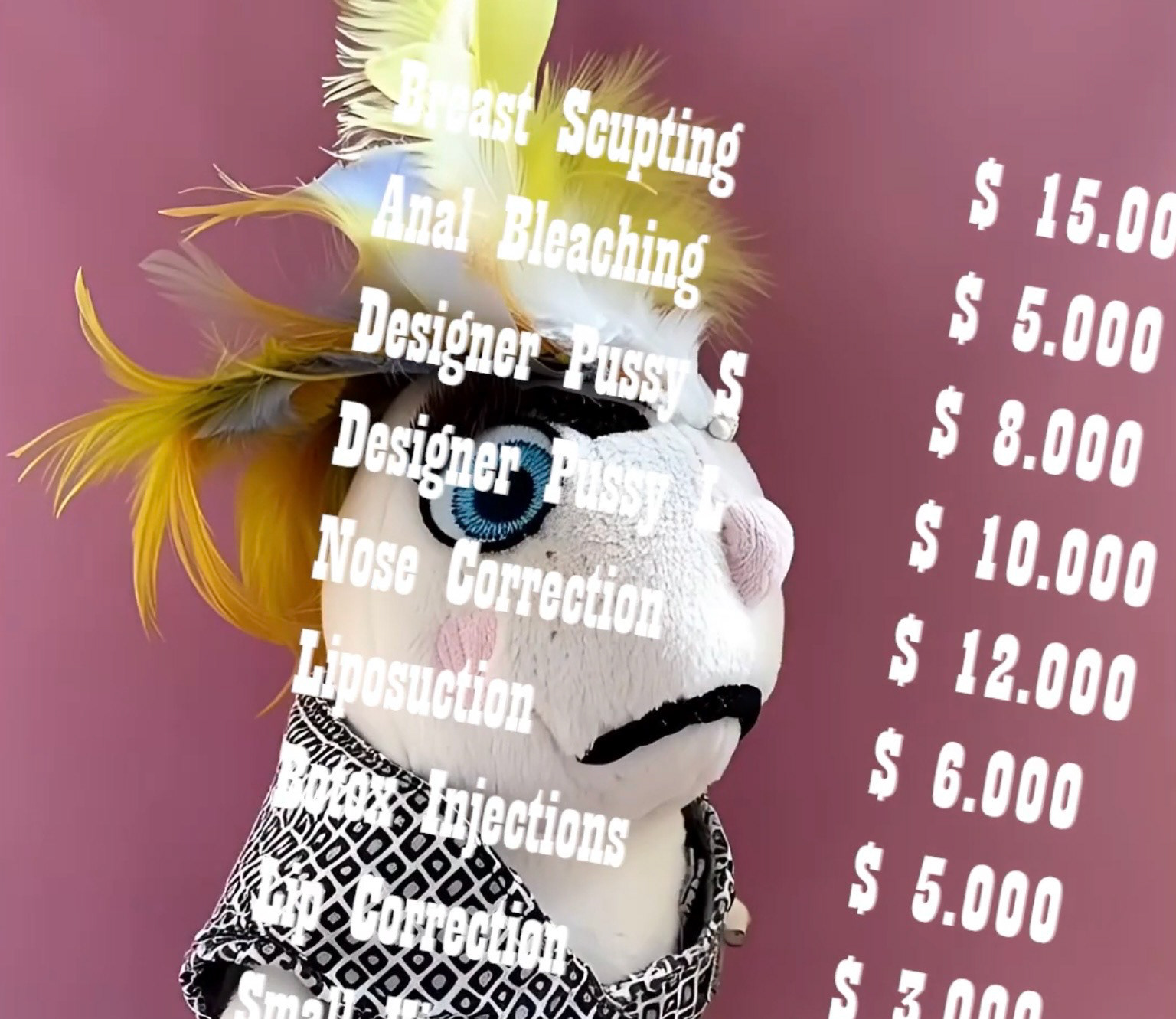
1. The video addresses a satirical price list for procedures like "Anal Bleaching," "Designer Pussy," and "Liposuction." How does this commodification of the body reflect the ways algorithms and platforms turn our physical appearance into transactional assets?
The price list exaggerates a reality that already exists. Social media platforms and algorithms reward visibility, perfection, and conformity, turning appearance into a form of social currency. By presenting cosmetic procedures as products on a menu, we expose the absurd logic of a culture in which the body is treated as something to optimize, market, and consume. Our work is not a critique of cosmetic surgery itself, but of the systems that continuously redefine what is considered beautiful, desirable, and successful
The price list exaggerates a reality that already exists. Social media platforms and algorithms reward visibility, perfection, and conformity, turning appearance into a form of social currency. By presenting cosmetic procedures as products on a menu, we expose the absurd logic of a culture in which the body is treated as something to optimize, market, and consume. Our work is not a critique of cosmetic surgery itself, but of the systems that continuously redefine what is considered beautiful, desirable, and successful
2. The character Zeefluweel guides the viewer through this landscape of "perfection." What is the conceptual origin of Zeefluweel, and how does this character's gaze help us deconstruct the collective pressure of endless self-representation?
Zeefluweel is a fictional creature who observes the human world with curiosity rather than judgment. As an outsider, Zeefluweel is not trapped by our social conventions, making the absurdity of our behaviour more visible. This perspective allows us to question the endless pressure to perform, perfect, and present ourselves for others. Instead of offering answers, Zeefluweel invites viewers to look at familiar realities with fresh eyes and rediscover the value of authenticity, vulnerability, and play.
3. In a world dominated by beauty ideals designed for screens, do you believe our actual flesh is being subverted to match the rigid standards of the digital interface?
We believe the relationship has gradually reversed. Instead of digital images reflecting reality, reality is increasingly expected to resemble digital images. Filters, editing tools, and algorithm-driven beauty standards have normalized unrealistic ideals, encouraging people to adapt their bodies to fit the screen rather than the other way around. Our work questions this shift and asks what is lost when authenticity is replaced by optimization, and when human diversity gives way to algorithmic perfection
4. Humor plays an essential role in this piece. Why do you find satire and irony to be effective entry points for discussing deeply distressing trends like algorithmic dysmorphia and body optimization?
Humour allows us to approach difficult subjects without becoming moralistic. It creates a moment of recognition before reflection. People may first laugh at the absurdity of the price list, only to realise that every procedure actually exists. Satire exposes how easily we accept extreme ideas once they become normalised. By balancing humour with discomfort, we invite viewers to question the systems behind these trends rather than judge the people who are affected by them.
REGARDING THE ARTWORK "ZEEFLUWEEL IN THE LAND OF THE SCAPEGOATS" (2026)
1. This work transitions into themes of exclusion, social conformity, and the phenomenon of the "scapegoat." How do automated algorithmic structures accelerate online tribalism and collective judgment?
Answer:
Automated algorithms do not create prejudice; they amplify it. Designed to maximize engagement, they reward outrage, certainty, and emotional polarization. As a result, people are quickly sorted into opposing tribes, while nuance and doubt disappear. Once someone is marked as different, the logic of the algorithm reinforces collective judgment through repetition, visibility, and social validation. In this way, digital systems can transform ordinary disagreement into public scapegoating, making exclusion feel both inevitable and justified.
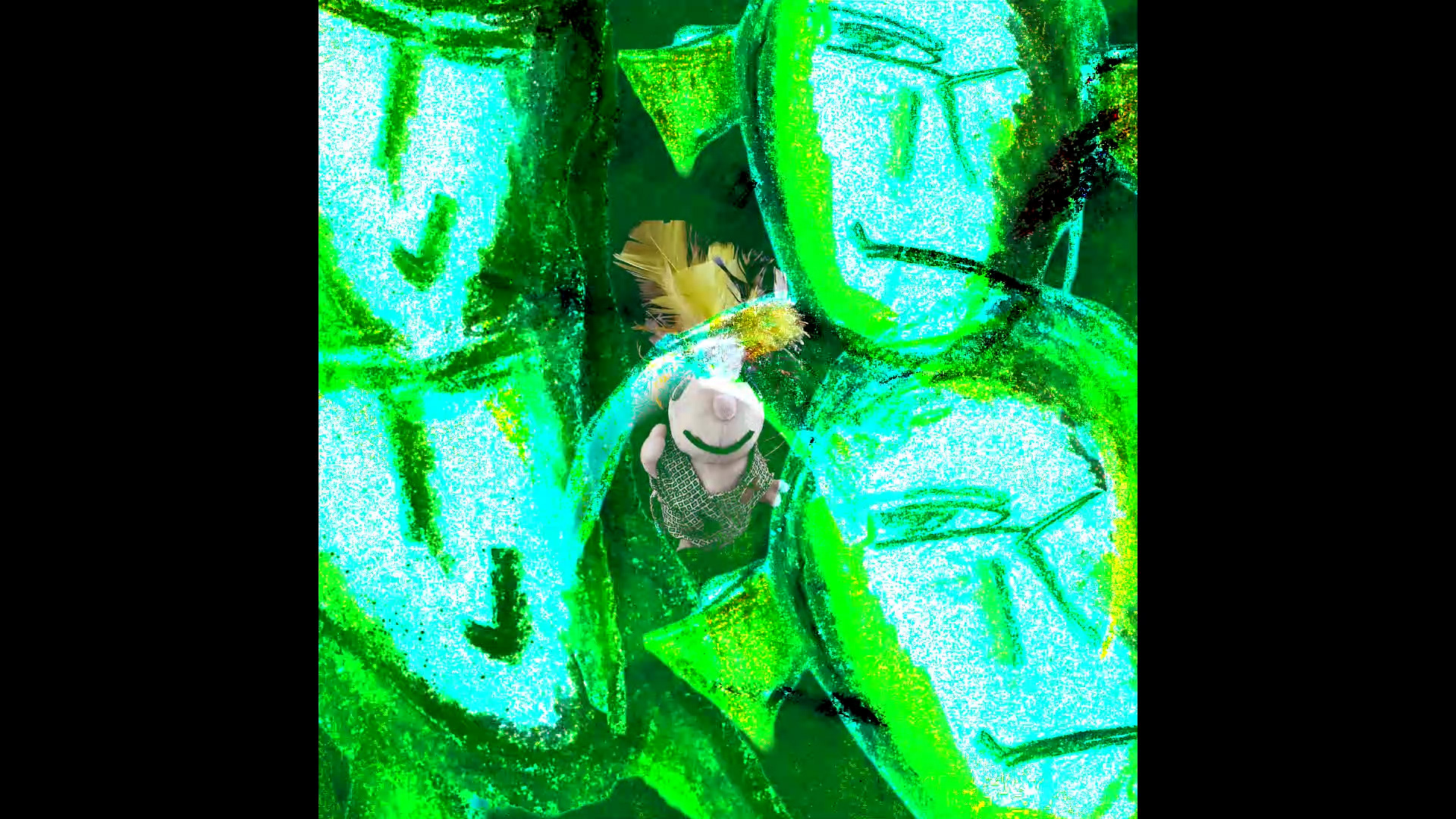
2. The visual environment features heavy green tones and expressive, distorted faces surrounding the central character. How does this specific painterly and textured digital aesthetic amplify the psychological weight of social exclusion?
Algorithms do not create tribalism; they amplify it. By rewarding engagement, outrage, and certainty, digital platforms encourage people to divide the world into “us” and “them.” Scapegoating becomes an efficient way to strengthen group identity, often at the expense of empathy and nuance. In Zeefluweel in the Land of the Scapegoats, we explore how these mechanisms are not new, but are accelerated and made more visible by digital technologies. The work is ultimately about a deeply human tendency that has found a powerful new amplifier.
3. When identity is continuously categorized, quantified, and mediated through interfaces, what crucial aspects of the human condition do you feel are left behind or entirely flattened?
What gets lost cannot be measured. Vulnerability, ambiguity, contradiction, silence, and the freedom to change are difficult to translate into data. Digital systems reduce identity to categories, preferences, and behavioural patterns, while human beings are fluid, inconsistent, and constantly evolving. Our work questions what remains of a person when complexity is compressed into a profile that can be classified, predicted, or judged.
What gets lost cannot be measured. Vulnerability, ambiguity, contradiction, silence, and the freedom to change are difficult to translate into data. Digital systems reduce identity to categories, preferences, and behavioural patterns, while human beings are fluid, inconsistent, and constantly evolving. Our work questions what remains of a person when complexity is compressed into a profile that can be classified, predicted, or judged.
INTERSECTION WITH THE THEME: "THE SELF AS INTERFACE"
1. Both of your submitted works actively map out how the body and the psyche function as operational zones between algorithmic logic and raw human emotion. How do you define the exact point where "the self" ends and the "interface" begins?
We do not believe there is a clear boundary. The interface is no longer simply a screen; it has become part of how we experience ourselves and others. Every click, recommendation, and digital interaction subtly shapes perception and behaviour. Yet beneath these layers remains something algorithms cannot fully access: memory, imagination, doubt, compassion, and lived experience. Our work exists precisely within that tension between technological mediation and irreducible humanity.
2. Given your experience showcasing works across both physical spaces and virtual reality platforms, how do you expect the tangible, hybrid space of Galeria 5ª ao Sul to influence how a viewer confronts Zeefluweel’s narrative?
A physical exhibition changes the pace of the encounter. Unlike online environments that encourage rapid consumption, the gallery invites viewers to slow down, observe, and reflect. Zeefluweel is not confined to the digital realm; he exists as a recurring physical presence within our artistic practice while simultaneously inhabiting virtual spaces. This movement between realities mirrors the way contemporary identity is continuously negotiated between the physical and the digital. Experiencing the work in the hybrid environment of Galeria 5ª ao Sul makes that dialogue tangible and reminds viewers that the mechanisms of exclusion exist both online and in everyday life.
A physical exhibition changes the pace of the encounter. Unlike online environments that encourage rapid consumption, the gallery invites viewers to slow down, observe, and reflect. Zeefluweel is not confined to the digital realm; he exists as a recurring physical presence within our artistic practice while simultaneously inhabiting virtual spaces. This movement between realities mirrors the way contemporary identity is continuously negotiated between the physical and the digital. Experiencing the work in the hybrid environment of Galeria 5ª ao Sul makes that dialogue tangible and reminds viewers that the mechanisms of exclusion exist both online and in everyday life.
3. Ultimately, do your experimental moving images serve as a warning of an algorithmic dystopia, or do they aim to uncover a baseline of true human belonging beneath the digitized noise?
Our work is not driven by fear of technology or visions of an algorithmic dystopia. Instead, we explore how digital systems expose timeless human behaviours: the desire to belong, the fear of exclusion, and the search for identity. Beneath the algorithmic noise, we believe there remains a deeply human capacity for empathy, imagination, and connection. If our work offers a warning, it is not about technology itself, but about what we lose when we stop seeing one another as complex human beings.