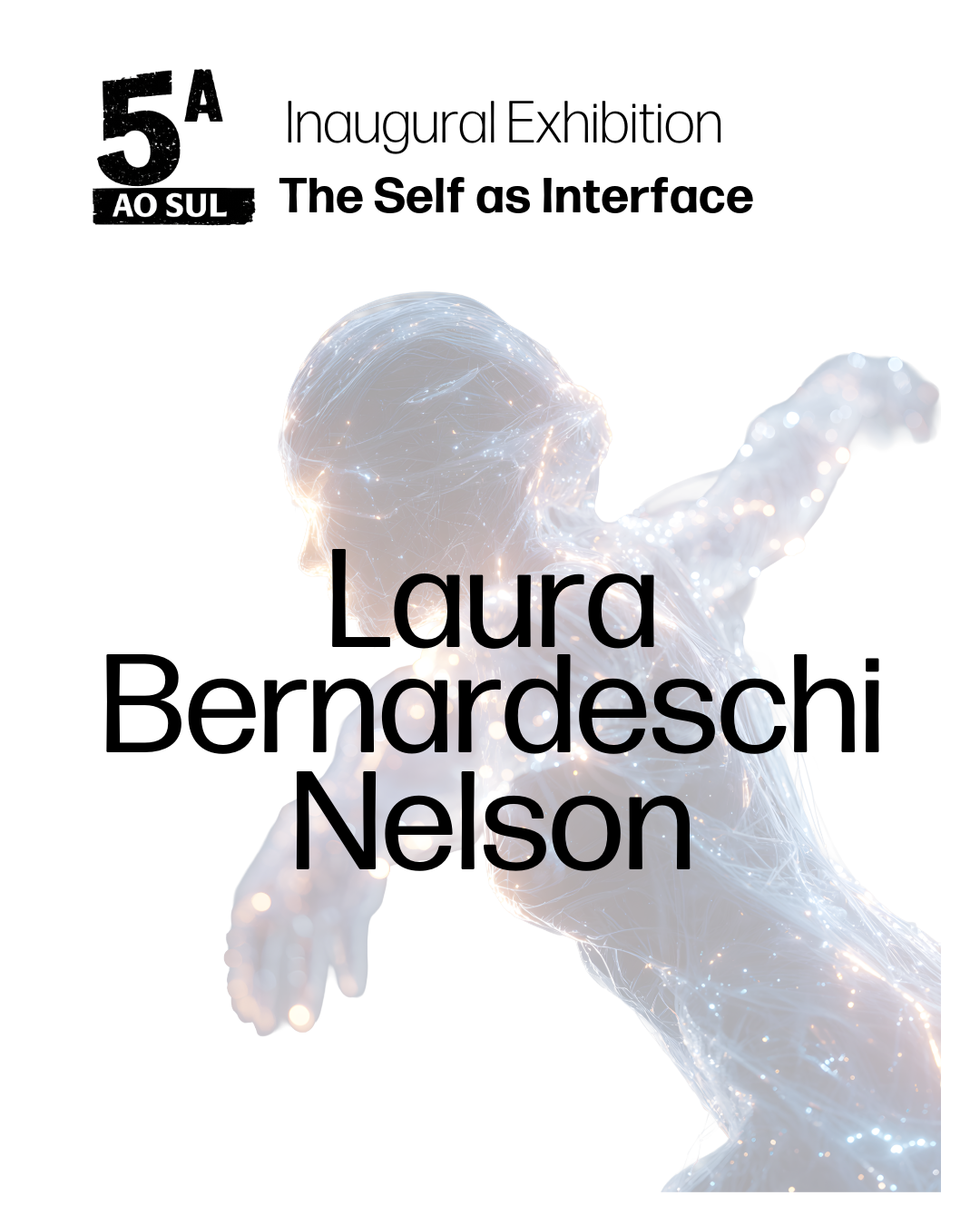
1. BIOGRAPHICAL DATA & CONTACTS
Full Name: Laura Nelson
Artist Name: Laura Bernardeschi Nelson
Nationality: British/Italian
Country of Residence: UK
Website: www.lauraartist68.uk
Social Media (Instagram / Others): instagram @lauranelsonartist68
Full Name: Laura Nelson
Artist Name: Laura Bernardeschi Nelson
Nationality: British/Italian
Country of Residence: UK
Website: www.lauraartist68.uk
Social Media (Instagram / Others): instagram @lauranelsonartist68
2. ARTISTIC CAREER & ARTISTIC STATEMENT
Short Bio / Artistic Career:
Laura Bernardeschi Nelson is an Italian-born, UK-based multidisciplinary contemporary artist and published author. Her practice spans painting, mixed media, digital, and post-digital formats, alongside literary writing, to investigate the fluid boundaries between the visible and invisible dimensions of human experience.
Grounded in themes of psychological thresholds, memory, identity, and resilience, Bernardeschi Nelson explores how the individual navigates both physical and intangible environments. Her visual language relies on symbolic imagery, layered narratives, and an ongoing dialogue between figurative and abstract elements. Her background as a published author deeply informs this approach, allowing visual storytelling, metaphor, and conceptual narrative to seamlessly intersect.
Artistic Statement:
Her recent body of work increasingly examines the self as a mediated entity within contemporary networks. By reflecting on technology, digital space, and systems of connectivity, she investigates how identity expands beyond the physical body—becoming fragmented, reconstructed, and echoed across virtual and memory-based structures.
Bernardeschi Nelson has exhibited internationally in curated physical and digital exhibitions across the UK, Europe, and global virtual spaces. Her work is also represented on major international platforms, including Saatchi Art, Artmajeur, and Artavita.
Grounded in themes of psychological thresholds, memory, identity, and resilience, Bernardeschi Nelson explores how the individual navigates both physical and intangible environments. Her visual language relies on symbolic imagery, layered narratives, and an ongoing dialogue between figurative and abstract elements. Her background as a published author deeply informs this approach, allowing visual storytelling, metaphor, and conceptual narrative to seamlessly intersect.
Artistic Statement:
Her recent body of work increasingly examines the self as a mediated entity within contemporary networks. By reflecting on technology, digital space, and systems of connectivity, she investigates how identity expands beyond the physical body—becoming fragmented, reconstructed, and echoed across virtual and memory-based structures.
Bernardeschi Nelson has exhibited internationally in curated physical and digital exhibitions across the UK, Europe, and global virtual spaces. Her work is also represented on major international platforms, including Saatchi Art, Artmajeur, and Artavita.
GENERAL CONTEXT AND PRACTICE
1. As an Italian-born, UK-based multidisciplinary artist and published author, your work spans painting, mixed media, digital/post-digital approaches, and literature. How does your literary background in fiction and visual storytelling shape the symbolic layers and narrative thresholds in your post-digital visual art?
My background in writing fiction—including my dystopian story The Grey Reign—directly influences my visual art.
Writing dystopian stories taught me how to show the struggle of a person facing complex, invisible systems. In The Grey Reign, I explore the pressure of living in a system with absurd rules and toxic dynamics. In my visual art, I use that same storytelling approach to explore how we live inside digital networks.
Writing helped me understand how to build a story using symbols and mood instead of just words. When I create post-digital artwork, I don't just create a picture—I build a world with a deeper story behind it. The figures and digital connections in my art act like characters and themes in a book. It helps the viewer step inside the artwork and think about how technology and society affect who we are.
2. Your practice frequently investigates invisible systems, psychological thresholds, and human resilience. How do you approach the transition from traditional, tangible media (such as painting) to post-digital imagery that explores immaterial networks?
I see our world as deeply interconnected by networks, both visible and invisible. We live surrounded by unseen webs of technology, data, shared memories, and human relationships that shape our daily experience.
For me, transitioning from traditional media like painting to post-digital art was a natural choice. Painting is wonderful for structure and texture, but digital imagery gives me the tools to build complex, layered worlds that express these invisible dimensions.
Post-digital tools allow me to blend light, code, and figurative shapes to make the "unseen" visible. Through this medium, I can visually show how human identity now exists at the threshold between the physical body and these vast immaterial networks. It is the perfect language to explore human resilience in a world where we are constantly connected yet often isolated.
REGARDING THE ARTWORK "BEYOND THE SELF" (2026)
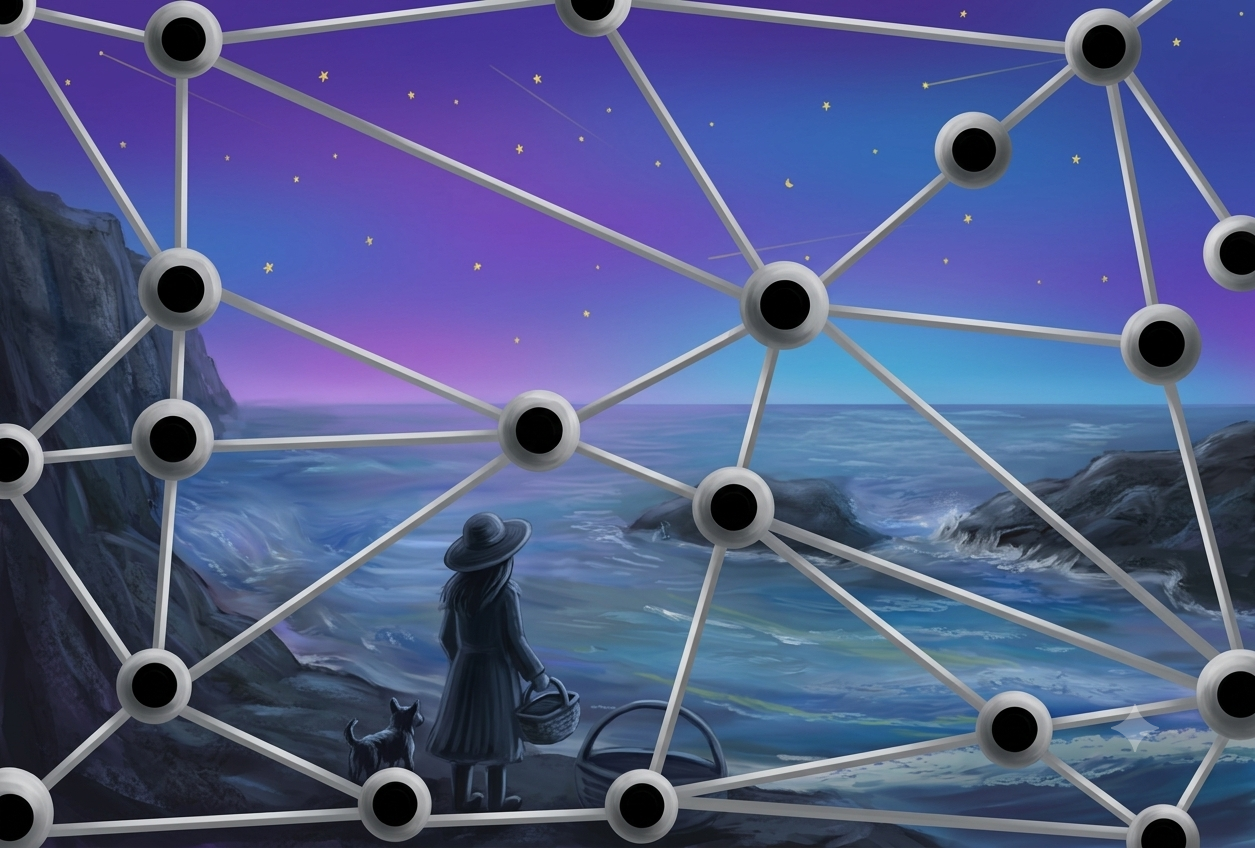
1. In "Beyond The Self," a solitary silhouetted figure stands on a cliffside facing a vast landscape, overlaid
with a geometric network of interconnected nodes and lines. What inspired this visual tension between the romantic, physical horizon and the cold, systemic web of data?
The tension in Beyond The Self comes from a contrast we all experience every day: the desire for authentic human connection with nature and ourselves, versus the cold, structured digital systems that surround us.
I was inspired by the classic Romantic idea of a figure looking out at a vast horizon—a symbol of freedom, contemplation, and inner emotion. But today, we never look at nature or the world with "pure" eyes anymore. Our perception is always filtered through screens, algorithms, and networks of data.
Overlaying the geometric network onto the natural cliffside makes that invisible layer visible. The network can represent many things: technology, social connections, data, or even shared memories. By placing the silhouetted figure at this exact boundary, I wanted to capture the feeling of modern life—standing in a physical place, yet being connected to an immaterial, infinite web that is both fascinating and isolating.
2. The network in "Beyond The Self" acts simultaneously as a lens, a filter, and a cage over the natural world. Does this web represent an expansion of human consciousness through connection, or does it depict the mediation and isolation of the individual in contemporary digital space?
It is definitely both, because technology is double-edged, but I feel that it increasingly leans toward isolation.
On one hand, the network offers an expansion of consciousness—it connects us instantly across the globe and gives us access to infinite information. On the other hand, it acts as a filter and a cage. Having lived in a time before this technology existed, I remember spending hours sharing real life face-to-face with true friends. Today, we often confuse digital contacts and "social media friends" with authentic human connections, but they are not the same.
In Beyond The Self, the web reflects this exact dilemma. It shows how modern technology gives us the illusion of being hyper-connected while actually mediating our experiences and isolating us behind screens. Whether the network feels like an extension of the self or a digital cage ultimately depends on the moment, but the quiet solitude of the figure highlights the growing sense of loneliness in our digital age.
3.
The figure appears in silhouette, stripped of specific facial traits or personal features. How does this disembodied presence allow the viewer to project their own identity onto the threshold between the physical body and the digital network?
By rendering the figure as a featureless silhouette, I wanted to make the image universal. This is a situation that affects every single one of us today.
To live and function in modern society, we are almost forced to connect to the network—it is no longer optional. However, this constant digital presence often comes at a cost. As we adapt to algorithms, profiles, and online expectations, we risk losing our unique identity and hiding our real emotions. We slowly become like faces without features.
The disembodied silhouette acts as an open mirror. Without specific traits, age, or gender, any viewer can step into the figure’s place. It allows people to reflect on their own relationship with the digital world and ask themselves: am I using the network, or is the network stripping away my real self?
The figure appears in silhouette, stripped of specific facial traits or personal features. How does this disembodied presence allow the viewer to project their own identity onto the threshold between the physical body and the digital network?
By rendering the figure as a featureless silhouette, I wanted to make the image universal. This is a situation that affects every single one of us today.
To live and function in modern society, we are almost forced to connect to the network—it is no longer optional. However, this constant digital presence often comes at a cost. As we adapt to algorithms, profiles, and online expectations, we risk losing our unique identity and hiding our real emotions. We slowly become like faces without features.
The disembodied silhouette acts as an open mirror. Without specific traits, age, or gender, any viewer can step into the figure’s place. It allows people to reflect on their own relationship with the digital world and ask themselves: am I using the network, or is the network stripping away my real self?
INTERSECTION WITH THE THEME: "THE SELF AS INTERFACE"
1.
Your artwork directly raises a diagnostic question: "Where does the self end when our experiences, memories, and identities increasingly exist through mediated and digital spaces?" Within the conceptual frame of "The Self as Interface," do you see this network as an extension of the human soul or as an artificial boundary replacing real human connection?
I see this network increasingly as an artificial replacement for real human connection.
While technology undoubtedly makes life easier and more convenient, it often happens at the expense of our true identity, personality, and critical thinking. I often find myself reflecting on this—even in personal conversations with my husband, where I express a fascination with living long enough to see future household robots and fully autonomous cars. The future promises ease and efficiency, but there is a hidden cost.
When interfaces and automated systems mediate everything, we risk being conditioned to behave like machines ourselves: always agreeable, passive, and compliant with decisions imposed from above.
The network does not extend the human soul; it replaces the raw, complex, and sometimes difficult nature of genuine human relationships with a simplified, controlled environment. Instead of enriching who we are, it encourages us to trade our authentic emotional depth for convenience, effectively turning the self into a standardized interface.
2.
When exhibiting "Beyond The Self" inside Galeria 5ª ao Sul's virtual 3D gallery space, how do you envision online viewers—who are themselves navigating through an invisible network of nodes and servers— interacting with this meta-reflection of their own digital presence?
Exhibiting Beyond The Self in a virtual 3D gallery creates a powerful loop of self-awareness. Online viewers are literally using their devices, navigating nodes and servers, to look at an artwork about people navigating nodes and servers. They become an active part of the concept itself.
While this applies to everyone, it speaks most directly to younger generations who have grown up with a smartphone or laptop practically attached to their hands. For many, a huge portion of daily life, communication, and identity is mediated through screens. Navigating a virtual gallery to view Beyond The Self forces a moment of pause. It transforms a routine digital action—clicking, scrolling, moving through a simulated 3D room—into a meta-reflection.
My hope is that as viewers stand in that virtual space, looking at the solitary figure on the cliff, they realize they are in the exact same position. I want them to ask themselves: Where am I right now? Am I genuinely experiencing this art, or am I just another node interacting with data? By creating this mirror effect, the artwork encourages online visitors to become aware of their own digital presence and reconsider how much of their real self is being absorbed by the screen.
When exhibiting "Beyond The Self" inside Galeria 5ª ao Sul's virtual 3D gallery space, how do you envision online viewers—who are themselves navigating through an invisible network of nodes and servers— interacting with this meta-reflection of their own digital presence?
Exhibiting Beyond The Self in a virtual 3D gallery creates a powerful loop of self-awareness. Online viewers are literally using their devices, navigating nodes and servers, to look at an artwork about people navigating nodes and servers. They become an active part of the concept itself.
While this applies to everyone, it speaks most directly to younger generations who have grown up with a smartphone or laptop practically attached to their hands. For many, a huge portion of daily life, communication, and identity is mediated through screens. Navigating a virtual gallery to view Beyond The Self forces a moment of pause. It transforms a routine digital action—clicking, scrolling, moving through a simulated 3D room—into a meta-reflection.
My hope is that as viewers stand in that virtual space, looking at the solitary figure on the cliff, they realize they are in the exact same position. I want them to ask themselves: Where am I right now? Am I genuinely experiencing this art, or am I just another node interacting with data? By creating this mirror effect, the artwork encourages online visitors to become aware of their own digital presence and reconsider how much of their real self is being absorbed by the screen.