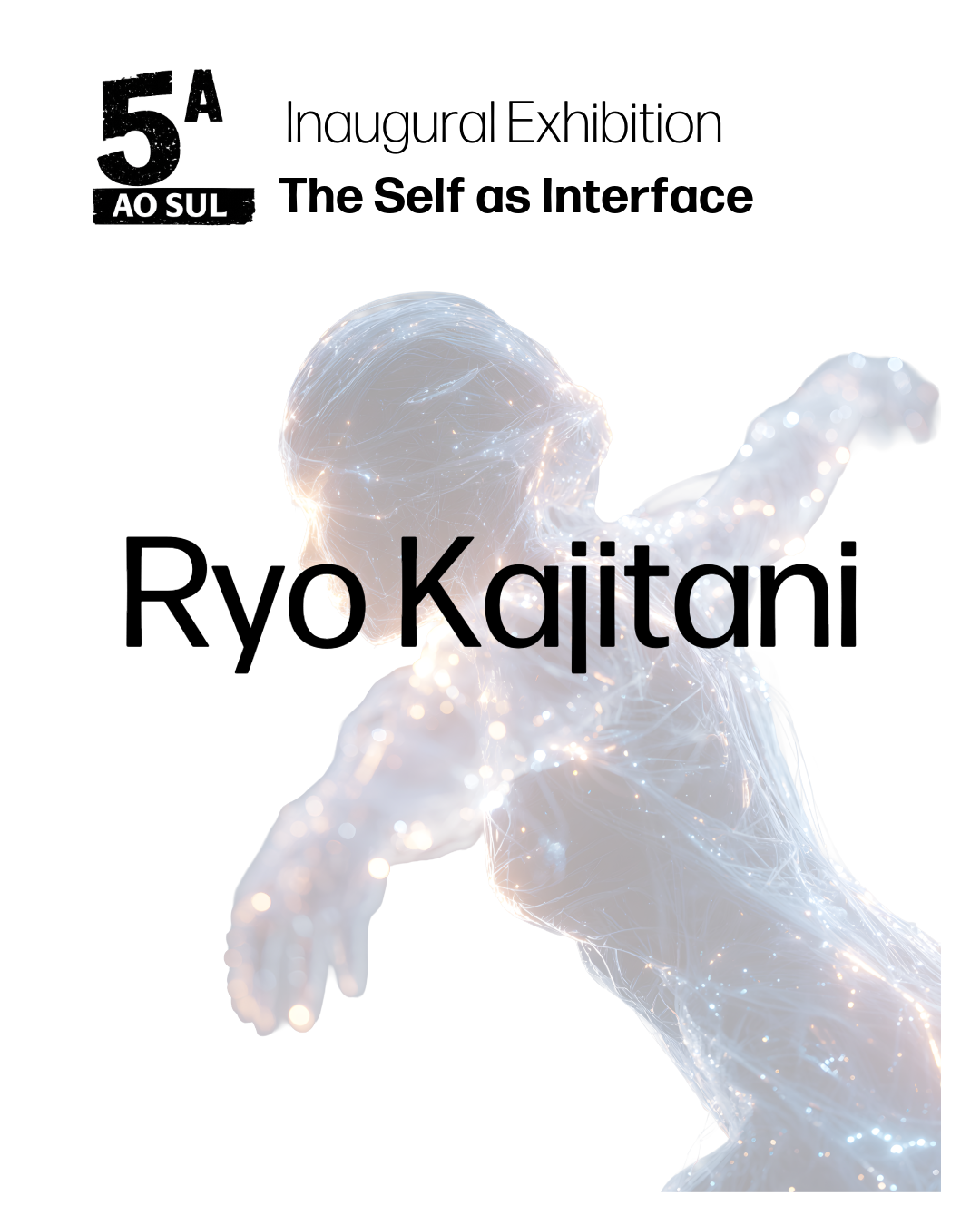
Artist Name: Ryo Kajitani
Nationality: Japanese
Country of Residence: Japan
Website: https://ryo-kajitani-site.pages.dev/
Social Media: Instagram: https://www.instagram.com/ryo_kajitani/
Nationality: Japanese
Country of Residence: Japan
Website: https://ryo-kajitani-site.pages.dev/
Social Media: Instagram: https://www.instagram.com/ryo_kajitani/
General Context and Practice
1 Your practice seamlessly merges traditional techniques like woodcut printmaking and hand drawing with advanced code-based processing and latent diffusion models. How do you conceptually bridge the physical weight of traditional printmaking with the ethereal nature of latent computational spaces?
In woodcut printmaking, the block resists the hand; incisions remain, while pressure, registration, and ink viscosity accumulate as irreversible decisions. The block retains a wound as a wound.
Latent diffusion does not retain a wound as a wound; it retains it only as a statistical relation. The real distance between these two processes lies in this difference in modes of retention. Latent diffusion operates through a trained checkpoint, compressed representations, probabilistic estimation, and iterative reconstruction.
The two processes nevertheless share a continuity in layering, constraint, repetition, delayed emergence, and the way one operation alters the conditions of the next.
At the level of the finished image, viewers can scarcely distinguish where documentary space ends and computational reconstruction begins. This visual continuity extends beyond technical finish and becomes an ontological aspect of the work.
Latent computational space also has a material infrastructure. Source photographs, my original dataset, trained parameters, storage media, hardware such as GPUs, electricity, code, and human intervention all participate as elements in the image's formation.
The bridge between woodcut printmaking and latent space is therefore better understood as the organization of distinct material and computational regimes within a single image that holds their differences as they are, rather than as an ambivalent opposition between material and immaterial media. The provenance of that image is difficult to determine by simply tracing its surface visually, yet every element in the work has a source in a documentary photograph, which is recalculated and transformed through latent-space computation.
The same condition can be seen in the image environment that surrounds us today. Provenance systems such as C2PA address a situation in which an image's production history and editing history can no longer be established from appearance alone.
In this work, that uncertainty—the fact that the seam cannot be found—is also a simple insight into how physical urban space and computational space already inhabit the same visible reality.
2 You hold a Ph.D. in Art from Tama Art University and have extensive experience in post-digital image practice. How does your academic framework interact with an artistic approach that you describe as an uncontrollable bodily experience or a "suicidal plunge" into computational noise?
An academic framework usually arrives after the event of the work. It follows, catches up, and approaches what the work has already made perceptible.
What matters is the tension that remains even as terms are gradually given to what has appeared and language takes on a body: this remains "speech about the work," rather than "the work speaking."
In my doctoral research, drawing on Heidegger's ontological thinking on art, I organized and provisionally theorized the modes of existence of primarily two-dimensional artworks in exhibition space as historical events in which the work, maker, exhibition space, and viewer participate.
That framework continues to provide a fundamental distinction and an orientation for understanding private bodily experience in relation to the structures through which that experience becomes visible: the city, the body, photographic apparatuses, social codes, archives, datasets, exhibition spaces, and institutions.
Most important is a posture of withdrawal: in relation to the work, the author's existence is somehow of little consequence.
The phrase "suicidal plunge" refers both to an acute psychological urgency of my own and to a concrete sequence of operations in the work. I select accumulated images from a private photographic archive, organize them into a dataset titled suicide, and use that dataset to train my own checkpoint.
It is, so to speak, a practical substitute for death—a technical destination for that plunge, a stage prepared beyond the actual urban environment.
Inside the trained model, the body becomes a trace and ceases to persist as a single human-readable photograph. Those traces disperse across learned parameters and are regenerated as another image through inference.
In this process, the image experiences a technical state of death before the actual body does. It loses a stable visual reference, moves into illegibility, and returns from latent space without recovering its original bodily axis.
The bodies and landscapes that emerge are, in a sense, posthumous portraits of the maker produced in advance. The image, whose heart has stopped, enters a posthumous state before the maker's body and reaches the other shore one step ahead of the maker.
The GPU that resuscitates that body—a single particle of social noise—might, in that sense, be called its heart.
The academic framework distinguishes the technical operation, bodily metaphor, and ontological claim contained in this process, while preventing the body from closing itself into a self-contained system.
When the trajectory of a body moving toward death is given a framework, the work simultaneously exposes the limits of language. The work always precedes both author and language, arising in advance while carrying its contradictions; language can only catch up afterward.
The two interact while remaining within an unresolved tension.
Regarding the "Garden of Prayer" Series (2023 / 2026)
1 You note that this series emerged from a sudden phantom pain experienced in 2021. How did physical trauma shift your practice toward what you define as a "somatic excavation" through digital means?
Response
The phantom pain I experienced in 2021 brought a past injury back as a present bodily problem. Even after the visible wound had closed and medical examinations showed no abnormality, the body retained the time of the event in other forms: phantom pain, postural tension, and memory.
I experienced it as something like a cry from the body. The work began with the body taking the lead, and I followed behind it. Gradually, through photographs and the process of making, I began to understand what was happening.
Until then, the documentary photographs had lain dormant as material for preserving the past. After the phantom pain, they became evidence of the past and, at the same time, strata that the present body could read backward through time.
Present pain flowed backward into past photographs, inscribing meanings that had not existed at the moment of exposure. The photographed body no longer remained a completed past; it kept changing its position within the body's ongoing history.
This physiological sense of continual repositioning found its way directly into collage as a working method. By then, my bodily sensation and the method of making were already seamlessly integrated.
At the same time, this integration became a bond that had to be overcome in order for the practice to continue. A practice that keeps running on trauma as fuel has clear limits for both mind and body. Another body, formed after the injury and equipped with another bodily axis, needed to be laid to rest and sent onward within the work.
"Somatic excavation" runs through the entire body of work as a technical method for digging through the layers of photography and computation to trace how the body's image has been formed, divided, and reread. It includes the relationships among body, memory, city, the photographer's gaze, the photographic apparatus, and the editing process.
Cutting, layering, blurring, moving into noise, encoding into latent space, and reconstructing the photographs call bodily traces belonging to different times back onto the present image plane. The pre-injury body remains an unreachable coordinate that the later body continues to reference.
This shift also seems to involve the gap between the measurable body and the lived body. Experiences such as the temporality of pain, the repetition of memory, and changes in posture are chaotic and unorganized; understanding them demands persistence.
Garden of Prayer explores what kind of image the residues held by the body can acquire through photography and computational processing by crossing that gap through the act of making.
Digital editing is a highly revealing surface for the excavation of bodily history. Long before it is made into an image, the body has already been edited by the city, social codes, perception, and memory.
Collage takes on the traces of that "editing" across different times and media and exposes the body again. It becomes a transformation through which I encounter “myself” again as an other.
2 In your process, personal record photographs are encoded into a personal dataset. How does it feel to convert highly intimate, fragmented memories into a structural mathematical framework like a feature space?
The transformation begins with selecting photographs. Which images enter the dataset? How are they cropped, repeated, excluded, named, and classified? When I step back and look at these decisions, they begin to feel curatorial.
The dataset provides the training material from which the model learns statistical relationships concerning my body and its surrounding environment; those relationships become distributed across the model's learned representations and parameters, rather than the dataset functioning simply as a neutral container for memory.
Within this process, I occupy several positions at once: the photographed subject, custodian of the archive, curator of the dataset, initiator of training, and editor of the returned images.
This structure operates under different conditions from the industrial collection of bodily images at scale, where images are detached from their original contexts and assigned to uses the photographed subjects never anticipated.
As "Datasheets for Datasets" has shown, a dataset has a purpose, composition, collection history, intended uses, and conditions of maintenance. Data takes shape through a history of selection.
There is also a contradiction in constructing the dataset myself. I determine the conditions by which the photographs are selected. Yet that very decision transforms private records into machine-readable statistical relationships that I myself can never fully translate back into their original terms or inspect.
Memory, bodily injury, posture, repetition, and photographic accident are transformed into statistical relations distributed across the model's weights. At that stage, no single parameter can truthfully be identified as "this memory."
Personal images and skin persist at the surface, yet they have moved away from a form that can be accessed as direct testimony.
Agency and estrangement coexist within this condition.
The archive moves beyond functioning only as evidence of what happened and becomes a probabilistic structure capable of generating what never happened.
This shift from a dormant record to probability creates an ethical tension in the work, I think. It feels like trying to live myself anew by breaking apart a private narrative and encountering myself again as an other.
Once the work is complete, this dataset is destroyed. In that sense, "burial" in this work is both a metaphor and a literal endpoint.
The transformation begins with selecting photographs. Which images enter the dataset? How are they cropped, repeated, excluded, named, and classified? When I step back and look at these decisions, they begin to feel curatorial.
The dataset provides the training material from which the model learns statistical relationships concerning my body and its surrounding environment; those relationships become distributed across the model's learned representations and parameters, rather than the dataset functioning simply as a neutral container for memory.
Within this process, I occupy several positions at once: the photographed subject, custodian of the archive, curator of the dataset, initiator of training, and editor of the returned images.
This structure operates under different conditions from the industrial collection of bodily images at scale, where images are detached from their original contexts and assigned to uses the photographed subjects never anticipated.
As "Datasheets for Datasets" has shown, a dataset has a purpose, composition, collection history, intended uses, and conditions of maintenance. Data takes shape through a history of selection.
There is also a contradiction in constructing the dataset myself. I determine the conditions by which the photographs are selected. Yet that very decision transforms private records into machine-readable statistical relationships that I myself can never fully translate back into their original terms or inspect.
Memory, bodily injury, posture, repetition, and photographic accident are transformed into statistical relations distributed across the model's weights. At that stage, no single parameter can truthfully be identified as "this memory."
Personal images and skin persist at the surface, yet they have moved away from a form that can be accessed as direct testimony.
Agency and estrangement coexist within this condition.
The archive moves beyond functioning only as evidence of what happened and becomes a probabilistic structure capable of generating what never happened.
This shift from a dormant record to probability creates an ethical tension in the work, I think. It feels like trying to live myself anew by breaking apart a private narrative and encountering myself again as an other.
Once the work is complete, this dataset is destroyed. In that sense, "burial" in this work is both a metaphor and a literal endpoint.
3 You introduce a profound conceptual framework where algorithmic "noising" acts as a burial, and "denoising" acts as a return. Can you elaborate on how Bayesian inference structurally mimics the psychological and physical process of stitching a traumatized body back together?
"Stitching" here has two sides: the repeated reassembly of a body that can exist in the present from fragments left in photographs, and a formal correspondence with the inferential structure of reverse diffusion.
In a diffusion model, the forward diffusion process gradually adds small amounts of noise to an image. The body's outline, posture, surface, and spatial relationships progressively lose legibility, eventually approaching a known noise distribution.
During training, the model is exposed to data perturbed at different noise levels. In the score-based continuous-time formulation used here to describe this process, the denoising network can be interpreted as estimating a time-dependent score field for those perturbed data distributions.
In that continuous-time formulation, the generative process is described by the reverse-time stochastic differential equation:
d x = [f(x,t) - g(t)^2 ∇_x log p_t(x)] dt + g(t) d w̄
The equation is solved with time running backward from the terminal prior toward the data distribution. f(x,t) is the drift of the forward SDE, g(t) is its scalar diffusion coefficient, and d w̄ denotes an increment of a standard Wiener process when time runs backward.
Technically, the central term is the score, ∇_x log p_t(x): the gradient of the log density of the perturbed data distribution at time t. It defines the direction in state space along which that log density increases most rapidly.
The model estimates the score at each stage and uses that direction to gradually precipitate structure from within the noise: contours, posture, depth, surface, and patterns perceived as a body.
Generation begins by drawing x(T) from the terminal prior p_T, typically a simple Gaussian distribution. Numerical integration of the reverse-time SDE then transports that sample back toward the data distribution p_0.
Under stochastic reverse-SDE sampling, the returning image is one among multiple possible realizations from the learned distribution. Even under the same conditioning, different initial noise or different stochastic trajectories can produce different bodies.
The Bayesian structure enters here at the level of conditional inference. In a discrete DDPM, the learned reverse process represents conditional transition distributions over less-noisy states given the current noisy state.
In the continuous-time score formulation above, that reverse-time logic is expressed through the learned time-dependent score field rather than by explicitly applying Bayes' rule at every step. For the work, this structure of inference under incomplete and noisy conditions provides the formal correspondence with stitching.
In terms of the artist's inner logic, the protocol of "generating by gradually destroying" is conceptually continuous with stitching a body back together from the traces of information dispersed by trauma.
After injury, the body forms a new continuity through pain, posture, tension, breathing, memory, photographs, absences, and interpretations added later.
That reconstruction begins from the already altered body of the present. Reverse diffusion likewise begins from the noisy state that exists at a given moment, referring to available traces and a learned distribution as it precipitates the next state step by step.
At the beginning of the project, my method resembled a rough therapeutic anatomy: cutting documentary photographs apart and anatomizing the injured body again. Bodily sensation and the operation of collage were already seamlessly connected.
Through trial and error, creative operations—cutting, layering, noising, estimation, reconstruction—came to connect directly with the engineering structure of diffusion models.
In latent diffusion models, a pretrained autoencoder encodes the image into a lower-dimensional latent representation, and the diffusion model is trained and sampled in that latent space.
After denoising, the autoencoder's decoder maps the latent representation back into image space. Latent space becomes an editing plane on which bodily fragments and multiple temporal states can be integrated into a single visual field.
I bring to this process a working stance: "throwing the body as noise—as a single particle of noise—into latent space."
In this process, I am not the protagonist. I participate as a single particle of social noise.
The body is offered to the editing process, loses legibility, and is returned from within the learned probability distribution.
Collage, too, is a technical metaphor for the editing that nature and society impose upon the body.
Through the city, memory, social codes, photographic apparatuses, datasets, and latent space, bodies from different moments are cut, layered, and stitched together on a single image plane.
Sensibility and engineering methods each carry a different side of the same editing process.
This analogy shifts the work's emphasis from restoration to reconstruction. Just as diffusion models precipitate patterns perceived by humans as meaningful structures according to a learned probability distribution, the work produces a new wholeness from a body fragmented after injury.
A seamless body appears at the surface. Inside it remain the technical stitches: initial noise, conditioning, score estimation, stochastic variation, compression into and decoding from latent representation, and the history of the artist's own selection and editing.
What returns from beyond the diffusion process is this coded body. It is still the body of the same human model, yet posture, proportion, center of gravity, contour, and relation to surrounding space have been reorganized; it is already supported around another bodily axis.
This presence is the "coded ghost": a body precipitated as a new wholeness from remaining traces and a learned distribution.
The work enters into dialogue with that body. I relinquish the authority to specify the exact form of its return, then wait for, observe, select, and edit the images returned by the model. In this sense, the project continues as a kind of waiting for a reply.
4 The entity that returns through this machine-learning process is not a restored original, but what you call a "coded ghost." How do you navigate the emotional and physical reality of living with a post-injury body supported by a completely new axis?
After injury, the body continues to reorganize itself through pain, defensive responses, posture, breathing, the direction of attention, and responses to the gaze of others.
The body's pre-injury central axis remains as the ruin of a lost reference point. The body that follows maintains daily life under a different center of gravity and a different tension.
The phrase another bodily axis begins with the literal axis of the torso that supports the model's body vertically. From there, posture, bodily proportion, center of gravity, legibility, and the way the body appears are organized.
The body that returns through latent diffusion is likewise reconstructed around another bodily axis while maintaining continuity with the source photograph.
Inside the checkpoint trained from my private dataset, the body is not stored as a single human-readable photograph. Its traces are distributed across learned parameters and appear as another bodily image when inference is run.
I treat this dormant state as one in which "the heart has stopped." The image has lost motion and has also lost the function of directly reflecting the original body.
When inference begins, the image acquires another pulse and returns from within the learned probability distribution.
What returns from there is the "coded ghost." It is a posthumous portrait made in advance, produced before the author's biological death.
The image experiences death before the body does, moves into illegibility, and takes form again around another axis.
At the center of my relationship with this body is coexistence with the body that has already changed. The pre-injury body remains as a reference, while the returned body carries intimacy and alterity at the same time. It emerges from my own photographs and memories and returns beyond the bounds of what I can properly call my own.
The emotional reality remains a condition in which loss, intimacy, estrangement, and reunion coexist.
To "live with what returns" means to respond to it persistently and patiently as something I face within the same bodily history, the same image, and the same reality.
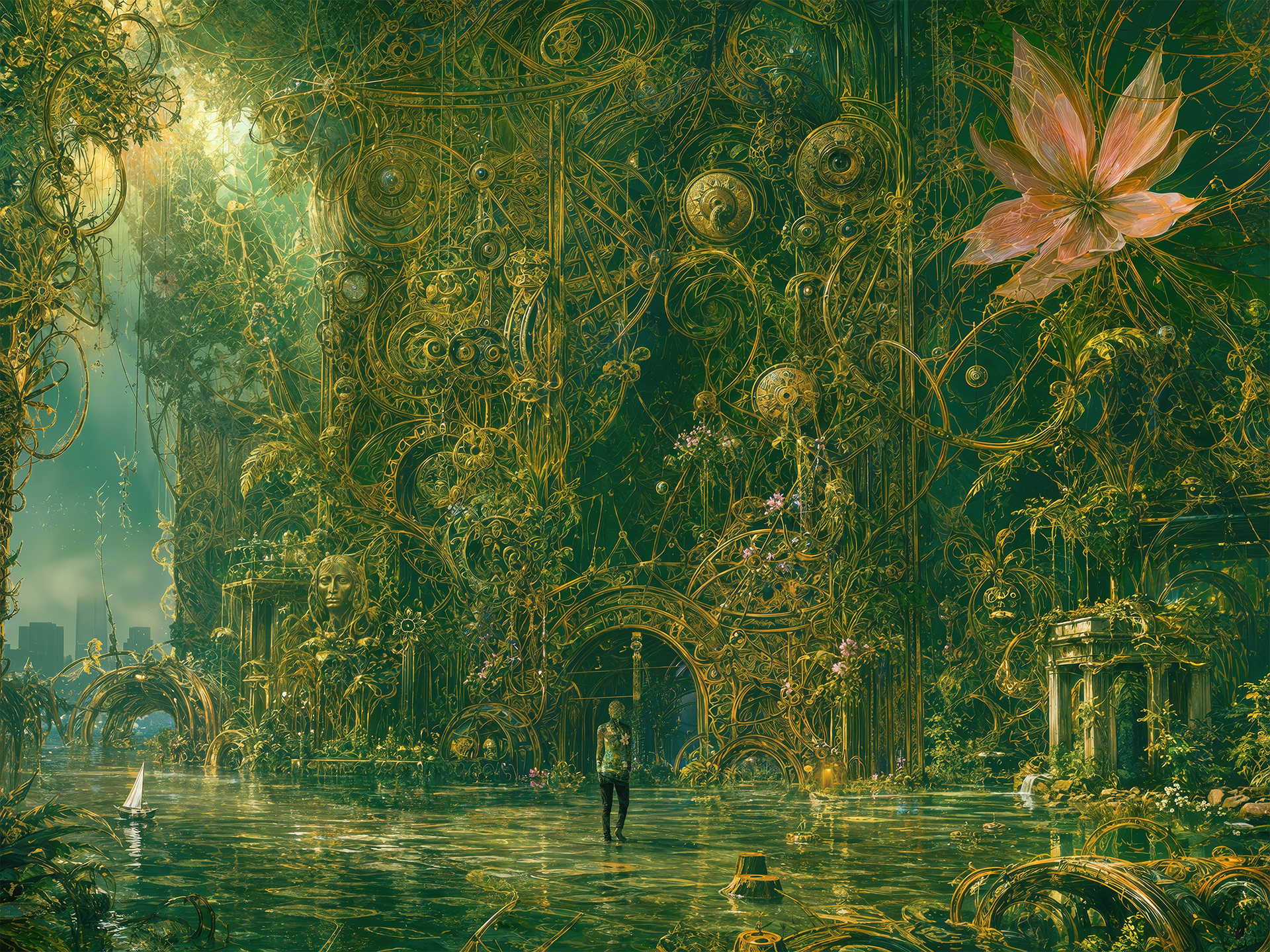
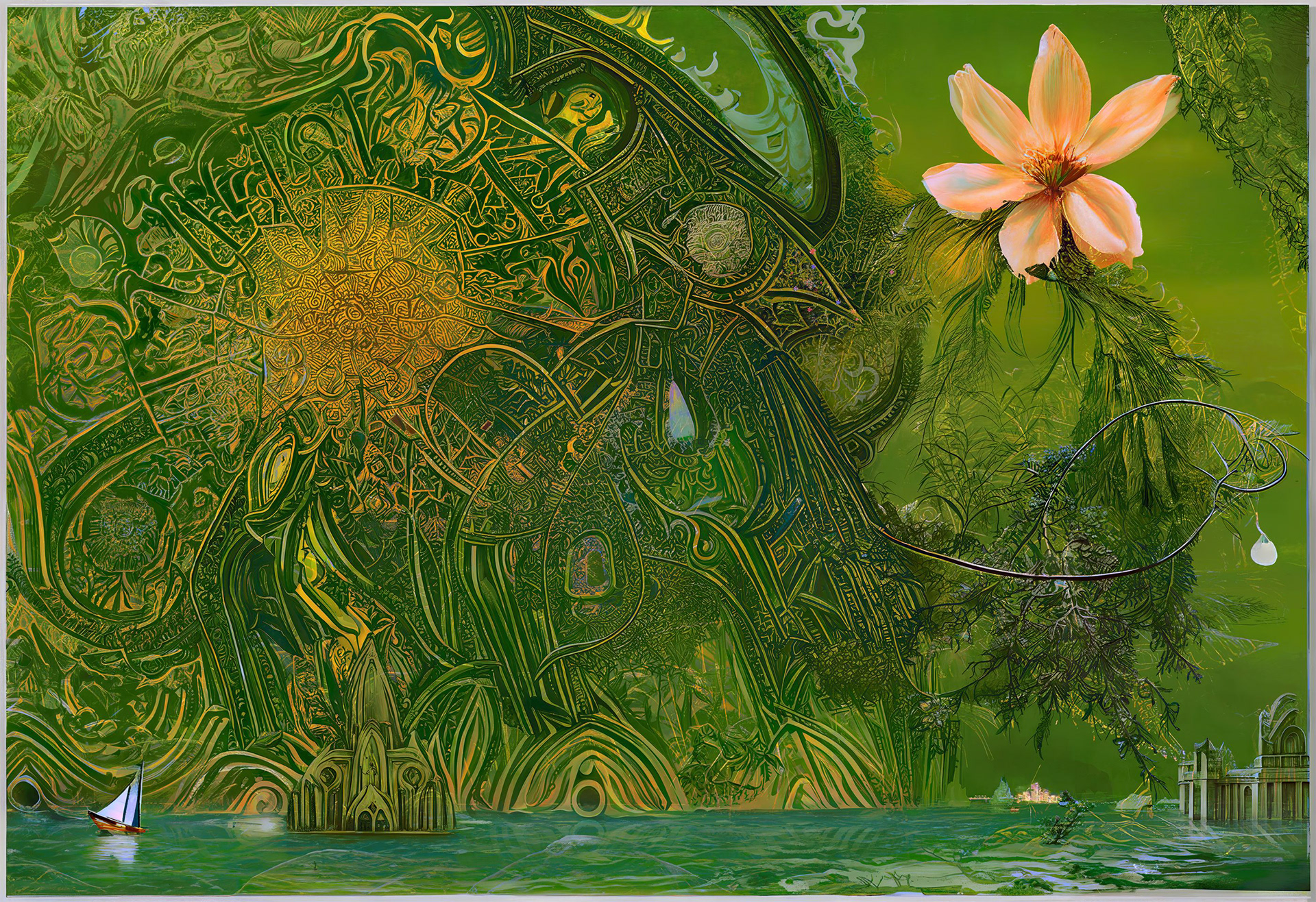
5 The visual landscapes in "Garden of Prayer" show circuit-like filaments, botanical structures, and ruins entangled without ever resolving into harmony. Does this lack of resolution represent a refusal to let technology comfortably sanitize human suffering?
I feel that this unresolved state expresses resistance to the desire to reshape human suffering into a processable problem and send it into a story that has already been resolved.
Technology can accelerate that desire, while also giving us a means of handling complexity as complexity.
Throughout the work, I try to keep events at their actual scale and to preserve their complexity as it is.
The surfaces of Garden of Prayer are visually seamless. Circuit-like filaments, plants, cities, ruins, anatomical fragments, and bodily images are so interconnected that their boundaries of origin disappear at first glance.
Visual seamlessness and conceptual reconciliation belong to different layers. Nature and machine retain their respective alterity, while wounds and memory remain in the image, carrying multiple times at once.
Inside the smooth surface, unresolved time and events coexist and breathe deeply.
Contemporary computational systems organize complex reality into processable forms through classification, prediction, optimization, and generation.
At the same time, diffusion models use noise itself as the probabilistic state from which generation begins. They can produce orderly sequences of input and output, problem and solution, injury and recovery; they can also treat disorder itself as a probability distribution and precipitate structure from within it.
The model sends the body into noise and then returns the body. Burial and stitching, loss and generation, proceed within the same process. This technical ambivalence sustains the work's unresolved state.
Human suffering often remains in forms of failure or collapse, sometimes staying in a single place for a very long time. Its traces wander without destination among nature, machines, memory, and the city, diffuse across the surface of reality without being resolved, and perhaps eventually blend into it.
6 You define "prayer" in these works not as a plea for divine salvation, but as a patient vigil for a reply from an opaque automated system. In an era of black-box AI, how can the act of waiting for a machine’s probabilistic response become a form of contemporary spirituality?
Prayer in this work is the act of continuing to offer attention and time to a system from which I need a reply, even though I cannot command the form or timing of its arrival. I prepare the conditions through inputs and operations, then wait for the response that follows.
Waiting includes setting conditions, observing outputs, selecting, rejecting, and editing. I construct the dataset, select checkpoints, and set images, masks, noise, and iteration parameters. I repeatedly look at the returned images, choosing the ones I can take responsibility for as works and carrying them into the next stage.
What I am waiting for is the reply itself: the form in which an image of my own body is returned after passing through latent space and noise.
The bodily image loses legibility and disperses within the learned probability distribution. With each inference, it returns as a body carrying another possibility of being.
The returned image derives from my photographs and bodily history, yet appears as a "coded body" supported around another bodily axis.
That reply carries intimacy, estrangement, reunion, and loss at the same time. Some images cannot be taken on as works and are rejected. Even so, I wait for the next response and continue the dialogue with the body that comes back.
Within this process, I relinquish the authority to fully anticipate the result while taking responsibility for the conditions from which the result emerges.
Responsibility remains across the entire process: which bodily images I offer, what data I use as training material, which images I select, and what I make public.
The opacity of black-box AI consists of multiple layers: internal computation, training data, design decisions, the labor of preparing data, hardware, electricity, and corporate operations. This opacity produces an asymmetry of knowledge and control between the person using the system and the processes operating within it.
Contemporary spirituality emerges as a practice of sustaining attention, patience, and responsibility in the face of that asymmetry. When a response is not guaranteed and its meaning cannot be fixed in advance, time opens up in which judgment is suspended and one remains with the returned image.
Prayer occurs within the "here and now" constituted by photographs, datasets, models, electricity, bodily history, and labor. A finite body enters into relation with a system it can never fully know or control, and spends time sustaining that relation.
This project is a message addressed to “myself” as an other, paired with the act of waiting for its reply. Without any guarantee that a reply will arrive, or that it will return in a desired form, I offer the bodily image and continue to speak with the body that is returned.
Prayer is a form through which a body that needs a reply relinquishes the authority to command its form and arrival, continues the vigil nevertheless, and takes responsibility for the body that returns.
Intersection with the Theme: "The Self as Interface"
1Your statement explicitly asserts that the self is not the stable origin of the image, but an interface through which code, trauma, urban space, and memory pass. How does this decentralization of the artist's ego change the traditional relationship between creator and artwork?
My Ph.D. dissertation (2019) placed the work, rather than the artist's ego, at the center of the artistic relation.
In The Origin of the Work of Art (GA 5, p. 26), Martin Heidegger writes that, in relation to the work, the artist remains something almost indifferent, almost like a passage that annihilates itself in the act of creation.
The work comes first; the maker withdraws behind it.
Chronologically, the living person and the labor of making precede the work. For me, however, the role of "maker" becomes legible only through a work that has already been made. Once completed, the work confronts the maker as another.
The maker then becomes the work's first viewer, becoming an other in relation to it, and prepares the ontological conditions under which the work can stand as itself.
This preparatory role continues in my current practice. Organizing photographic archives, constructing a private dataset, training and selecting checkpoints, setting the range of probabilistic variation, final editing, printing, framing, and exhibition are concrete parts of that work.
Through these operations, the maker establishes the conditions under which the work can emerge, while its subsequent course exceeds the maker's prior intention.
Decentering the ego can therefore be understood as releasing the work from the maker's sovereign self-expression and ownership. In practical terms, it shifts the maker's role toward preparation, care, and responsibility.
In The Origin of the Work of Art (GA 5, p. 58), Heidegger places die Schaffenden, those who create, and die Bewahrenden, those who preserve and watch over the work, within the work's Geschaffensein—its "createdness."
The work makes the creators possible and calls for those who preserve it. Exhibition, preservation, and viewing belong to the work's historical existence rather than arriving later as secondary reactions. Viewing is an activity through which the work continues to enter history.
A work can be exhibited, preserved, lost, rediscovered, and reinterpreted within a time that the maker can neither live through nor govern. Its material and conceptual existence exceeds the maker's temporal horizon.
In this sense, the work already stands ahead of the maker. The maker works to prepare future conditions for viewers, interpretations, and historical situations that are not yet known.
This temporal asymmetry brings the work into proximity with die vorlaufende Entschlossenheit—anticipatory resoluteness—developed in §62 of Being and Time. The term refers to an anticipatory relation to one's own finite possibilities.
Within my artistic framework, it describes a maker preparing for a future in which the work may continue to exist after the body that produced it is absent.
At the end of The Origin of the Work of Art (GA 5, p. 66), Heidegger describes reflective knowledge concerning art as a "preliminary and therefore unavoidable preparation."
This knowledge prepares a space for the work, a path for those who create, and a position for die Bewahrenden. My role as maker lies in that preparation: arranging the conditions through which the work emerges, stands apart from its maker, and enters a history that exceeds personal intention.
Accordingly, within the exhibition theme The Self as Interface, the maker or self becomes a pedestrian who passes through the work only temporarily, rather than its stable origin or final authority. What ultimately matters lies with viewers who traverse their own time.
2 You speak of a digital "other shore" that runs parallel to the physical urban environments we navigate daily. How do you see your works acting as a threshold or gateway between these two distinct spatial planes for the gallery visitor?
For me, latent space is a technical other shore into which the body is sent. There, the bodily image enters a posthumous state one step ahead of the author. The body recorded in photographs disperses into noise, loses legibility within learned parameters and probability distributions, and returns as another body.
This body is a posthumous portrait made in advance, preceding the portrait that would ordinarily be produced after the author's death. The title of my private dataset, suicide, also points to this temporal precedence. The bodily image is cast into the other shore before the author and, there, temporarily loses its original form and motion.
This other shore is materially constituted by actual bodies, photographs, memories, datasets, models, hardware, electricity, and labor. For a body tormented by loneliness and anxiety, it can become a place to cast itself into; yet that place is itself embedded within the physical and social reality in which we live.
Physical urban space and this technical other shore therefore exist on a continuum while remaining in different states. The body walking the street, the photographed body, the body dispersed in latent space, and the body returned through inference are different temporal states within the same bodily history.
The work functions as an entrance by withholding any visible line that would mark the boundary between these two spaces.
Photographed streets, bodily fragments, botanical structures, hand-drawn lines, and forms reconstructed by the model occupy a single continuous pictorial field.
The viewer first encounters them as one environment, then becomes aware that their origins cannot be reliably separated.
The boundary arises as an epistemological rather than an architectural one. It appears at the moment visual certainty begins to waver—the moment documentary reality and computational reconstruction are recognized as already embedded within one another.
The work makes it perceptible that the realm once regarded as another world is already operating within the reality from which the viewer began.
This structure is also present in the seamlessness of collage. The disappearance of the visual seam transfers the immanent relation between physical urban space and the technical other shore into the structure of the image.
By erasing the point where one world ends and the other begins, the image becomes an entrance connecting the two spatial planes.
The body that returns through that entrance is supported by an axis different from the one it had at the time of the photograph. Having experienced the other shore one step ahead of the author, it is returned to reality as a coded ghost and stands before the viewer.
The work is both an entrance and a reply. To the author who offered the body to the other shore, a body in another form returns; the viewer, too, witnesses that return.
3 By partially surrendering curatorial and creative control to the model’s probabilistic reconstructions, you ask an overarching question: "How do we continue to live with what returns?" How do you hope the hybrid space of Galeria 5ª ao Sul physically anchors this complex question for the public?
When the work enters public time, I hope that my private bodily history—formed under social pressures through which I came to experience my own body as "perverse"—can become a prompt for people with different bodily histories to re-examine their own transformations and returns before the same image.
A 3D exhibition space also has virtual walls, dimensions, distance, viewpoints, routes of movement, and relations of adjacency. By being placed there, the work acquires a place open to viewers.
The returned body thus meets viewers and spends time with them. Viewers approach the image, move away, look again from another angle, and continue to place their own bodies before the screen.
The physicality here—posture, gaze, virtual distance from the work, movement through space, duration of viewing, and the light of the monitor—and the experience it produces belong to the viewer's body in front of the screen.
The work becomes a single clue, a noise, and an interface through which to enter this question.
Behind this returned body are also the figures of many others, edited day by day through interfaces.
The process of editing a personal bodily history, woven day by day, is often forgotten once viewers return to their ordinary lives.
In today's networked life, part of the self's social appearance is formed and continually updated as multiple images while passing through photographs, profiles, posts, evaluations, searches, algorithms, and the gaze of actual others.
The self-images formed there remain active beyond the screen: they affect relationships, evaluations, work, memory, and the future, and at times assume social roles in place of the lived body.
In the work, the body organized around "another bodily axis" appears as a posthumous portrait that precedes the maker; at the same time, that axis opens onto a condition in which a transformed self lives anew through another posture, another center of gravity, and another legibility.
The circulation in which an image separated from the body comes to function as the person, and then acts back upon the physical body, is already part of the everyday reality experienced by many people.
Through the work, viewers may encounter the possibility that they, too, have passed through some apparatus of transformation and have come to live again around another axis.
When, through looking at "what returns," something that first appeared as an other becomes belatedly connected to one's own experience, a viewer may realize: "Ah, I see. I, too, was already a returned body."
That discovery of oneself can become an occasion to encounter oneself again.
When the work enters public time, I hope that my private bodily history—formed under social pressures through which I came to experience my own body as "perverse"—can become a prompt for people with different bodily histories to re-examine their own transformations and returns before the same image.
A 3D exhibition space also has virtual walls, dimensions, distance, viewpoints, routes of movement, and relations of adjacency. By being placed there, the work acquires a place open to viewers.
The returned body thus meets viewers and spends time with them. Viewers approach the image, move away, look again from another angle, and continue to place their own bodies before the screen.
The physicality here—posture, gaze, virtual distance from the work, movement through space, duration of viewing, and the light of the monitor—and the experience it produces belong to the viewer's body in front of the screen.
The work becomes a single clue, a noise, and an interface through which to enter this question.
Behind this returned body are also the figures of many others, edited day by day through interfaces.
The process of editing a personal bodily history, woven day by day, is often forgotten once viewers return to their ordinary lives.
In today's networked life, part of the self's social appearance is formed and continually updated as multiple images while passing through photographs, profiles, posts, evaluations, searches, algorithms, and the gaze of actual others.
The self-images formed there remain active beyond the screen: they affect relationships, evaluations, work, memory, and the future, and at times assume social roles in place of the lived body.
In the work, the body organized around "another bodily axis" appears as a posthumous portrait that precedes the maker; at the same time, that axis opens onto a condition in which a transformed self lives anew through another posture, another center of gravity, and another legibility.
The circulation in which an image separated from the body comes to function as the person, and then acts back upon the physical body, is already part of the everyday reality experienced by many people.
Through the work, viewers may encounter the possibility that they, too, have passed through some apparatus of transformation and have come to live again around another axis.
When, through looking at "what returns," something that first appeared as an other becomes belatedly connected to one's own experience, a viewer may realize: "Ah, I see. I, too, was already a returned body."
That discovery of oneself can become an occasion to encounter oneself again.
References
1. Ryo Kajitani
Towards Further Advancement of Artistic Activity in Exhibition Spaces: Exploring through the Ontological Aesthetics based on Heidegger's Der Ursprung des Kunstwerkes (The Origin of the Work of Art).
Ph.D. dissertation, Tama Art University, 2019.
2. Martin Heidegger
Holzwege (1935–1946), Gesamtausgabe Bd. 5.
Ed. Friedrich-Wilhelm von Herrmann.
Frankfurt am Main: Vittorio Klostermann.
3. Martin Heidegger
Sein und Zeit (1927), Gesamtausgabe Bd. 2.
Ed. Friedrich-Wilhelm von Herrmann.
Frankfurt am Main: Vittorio Klostermann.
4. Timnit Gebru, Jamie Morgenstern, Briana Vecchione, Jennifer Wortman Vaughan,
Hanna Wallach, Hal Daumé III, Kate Crawford
"Datasheets for Datasets."
Communications of the ACM, 64(12), 2021, pp. 86–92.
doi: 10.1145/3458723.
5. Jonathan Ho, Ajay N. Jain, Pieter Abbeel
"Denoising Diffusion Probabilistic Models."
Advances in Neural Information Processing Systems 33 (NeurIPS 2020).
6. Yang Song, Jascha Sohl-Dickstein, Diederik P. Kingma, Abhishek Kumar,
Stefano Ermon, Ben Poole
"Score-Based Generative Modeling through Stochastic Differential Equations."
International Conference on Learning Representations (ICLR), 2021.
7. Robin Rombach, Andreas Blattmann, Dominik Lorenz, Patrick Esser, Björn Ommer
"High-Resolution Image Synthesis with Latent Diffusion Models."
Proceedings of the IEEE/CVF Conference on Computer Vision and Pattern Recognition
(CVPR), 2022, pp. 10684–10695.
8. Coalition for Content Provenance and Authenticity (C2PA)
Content Credentials: C2PA Technical Specification, version 2.4, April 2026.