1. BIOGRAPHICAL DATA & CONTACTS
Full Name: Yiling Cao
Artist Name: Ling
Nationality: Chinese
Country of Residence: United Kingdom
Website: https://www.instagram.com/linglingcreative
Social Media (Instagram / Others): Instagram@linglingcreative
2. ARTISTIC CAREER & ARTISTIC STATEMENT
Short Bio / Artistic Career:
Ling (Yiling Cao) is an interdisciplinary artist and creative director based between London and Shanghai. She trained in psychology at the University of Manchester, translational neuroscience at Imperial College London, and global prosperity at UCL, before completing the 100 Design Projects programme at Central Saint Martins. During her degree in London from 2020 to 2025, she curated projects like Cloudy to Clear, [fi:l]D and Sustain the Rhythm internationally to promote public understanding in neuroscience and psychology, using art languages. Her paintings translate cognitive-science frameworks—attention, memory, mental ecology—into layered acrylic and mixed-media topographies. Recent solo presentations include The Moment and The Moment 2.0 (Shanghai, 2025–2026); group show credits include Nota Gallery, Fitzrovia Gallery and Indra Gallery in London, Studio Home Awareness in Milan, etc.
Ling (Yiling Cao) is an interdisciplinary artist and creative director based between London and Shanghai. She trained in psychology at the University of Manchester, translational neuroscience at Imperial College London, and global prosperity at UCL, before completing the 100 Design Projects programme at Central Saint Martins. During her degree in London from 2020 to 2025, she curated projects like Cloudy to Clear, [fi:l]D and Sustain the Rhythm internationally to promote public understanding in neuroscience and psychology, using art languages. Her paintings translate cognitive-science frameworks—attention, memory, mental ecology—into layered acrylic and mixed-media topographies. Recent solo presentations include The Moment and The Moment 2.0 (Shanghai, 2025–2026); group show credits include Nota Gallery, Fitzrovia Gallery and Indra Gallery in London, Studio Home Awareness in Milan, etc.
Artistic Statement:
My practice is grounded in the translation of neuroscientific insights into visual language. Trained in psychology and translational neuroscience, I approach the studio as an extension of the laboratory—a space where empirical observations of the mind are transmuted into sensory experiences. I utilize concepts such as memory, attention, and 'mental ecology' not as mere subjects, but as structural blueprints for my layered pigment topographies.
Rather than illustrating scientific data, my work renders the invisible mechanics of consciousness into tangible form. The objective is to forge a conduit between empirical rigor and subjective experience. While my starting point is deeply rooted in scientific inquiry, the resulting compositions are designed to elicit shared physiological and emotional resonances. In this sense, the artwork functions as an interface for collective cognition, inviting the audience to engage with the fundamental architectures of human perception and to discover their own reflections within these scientific landscapes.
3. CURATORIAL QUESTIONNAIRE: LING YILING CAO
GENERAL CONTEXT AND PRACTICE
1. Your academic and scientific background includes training from institutions such as Imperial College
London, The University of Manchester, and UCL, bridging cognitive neuroscience with sensory art. How does your empirical knowledge of human consciousness and brain ecology directly inform the
spontaneous, gestural marks of your abstract paintings?
1. Your academic and scientific background includes training from institutions such as Imperial College
London, The University of Manchester, and UCL, bridging cognitive neuroscience with sensory art. How does your empirical knowledge of human consciousness and brain ecology directly inform the
spontaneous, gestural marks of your abstract paintings?
My scientific training has not only transformed what I paint but has also reshaped my entire perspective on the act of painting itself. Artists with formal academic training often tend toward refining their techniques through decades of practice; as a cross-boundary artist, my foundation lies in cognitive neuroscience—specifically, the study of the mechanisms underlying thought and emotion. This enables me to use the canvas as a medium for visualizing neural activity, viewing the canvas not merely as a surface for composition, but as a space where neural activity is manifested—a process that extends far beyond mere composition and involves the creation of such a spatial realm. The spontaneous brushstrokes in my work represent an intuitive expression and translation of internal physiological pathways. When creating my paintings, I pay less attention to aesthetic formalism and instead focus on capturing raw neural impulses—the "electrical storms" of consciousness. My approach to painting is informed by my perception and understanding of the brain's ecology; this very understanding dictates the rhythm, intensity, and flow of my brushstrokes—they serve as echoes of synaptic transmission at the physiological level. Empirical science has not constrained my creativity; rather, it has provided a framework through which I can transform intangible mental states into visible, tangible forms—a method, in my view, of documenting neuro-aesthetics.
2. As both an artist and a creative director, your projects explore mental ecology and sustainable futures. How do you see the dematerialization of tactile, physical canvases into digital representations contributing to or challenging our current mental and environmental ecology?
De-materialization brings both opportunities and challenges. At the environmental level, digital communication reduces the carbon footprint associated with transportation, temperature-controlled warehousing, and on-site exhibitions—though we must acknowledge the energy costs incurred by data centers. In terms of the mental ecology, digital platforms have democratized access and eliminated geographical barriers. However, multidimensional experiences are "flattened" into pixels, posing a risk of diminishing the depth of engagement. The color expression and texture rendering inherent in thick-paint applications rely on tactile feedback to convey certain information—particularly emotions; this feedback, combined with the physical medium and the shared atmosphere found in gallery exhibitions, constitutes an embodied experience that screens struggle to replicate. In my view, I regard digital presentation as a vital extension—a means through which my artworks can transcend physical boundaries, reach a broader audience, be perceived by more people, and spark new intersections and possibilities.
De-materialization brings both opportunities and challenges. At the environmental level, digital communication reduces the carbon footprint associated with transportation, temperature-controlled warehousing, and on-site exhibitions—though we must acknowledge the energy costs incurred by data centers. In terms of the mental ecology, digital platforms have democratized access and eliminated geographical barriers. However, multidimensional experiences are "flattened" into pixels, posing a risk of diminishing the depth of engagement. The color expression and texture rendering inherent in thick-paint applications rely on tactile feedback to convey certain information—particularly emotions; this feedback, combined with the physical medium and the shared atmosphere found in gallery exhibitions, constitutes an embodied experience that screens struggle to replicate. In my view, I regard digital presentation as a vital extension—a means through which my artworks can transcend physical boundaries, reach a broader audience, be perceived by more people, and spark new intersections and possibilities.
REGARDING THE ARTWORKS
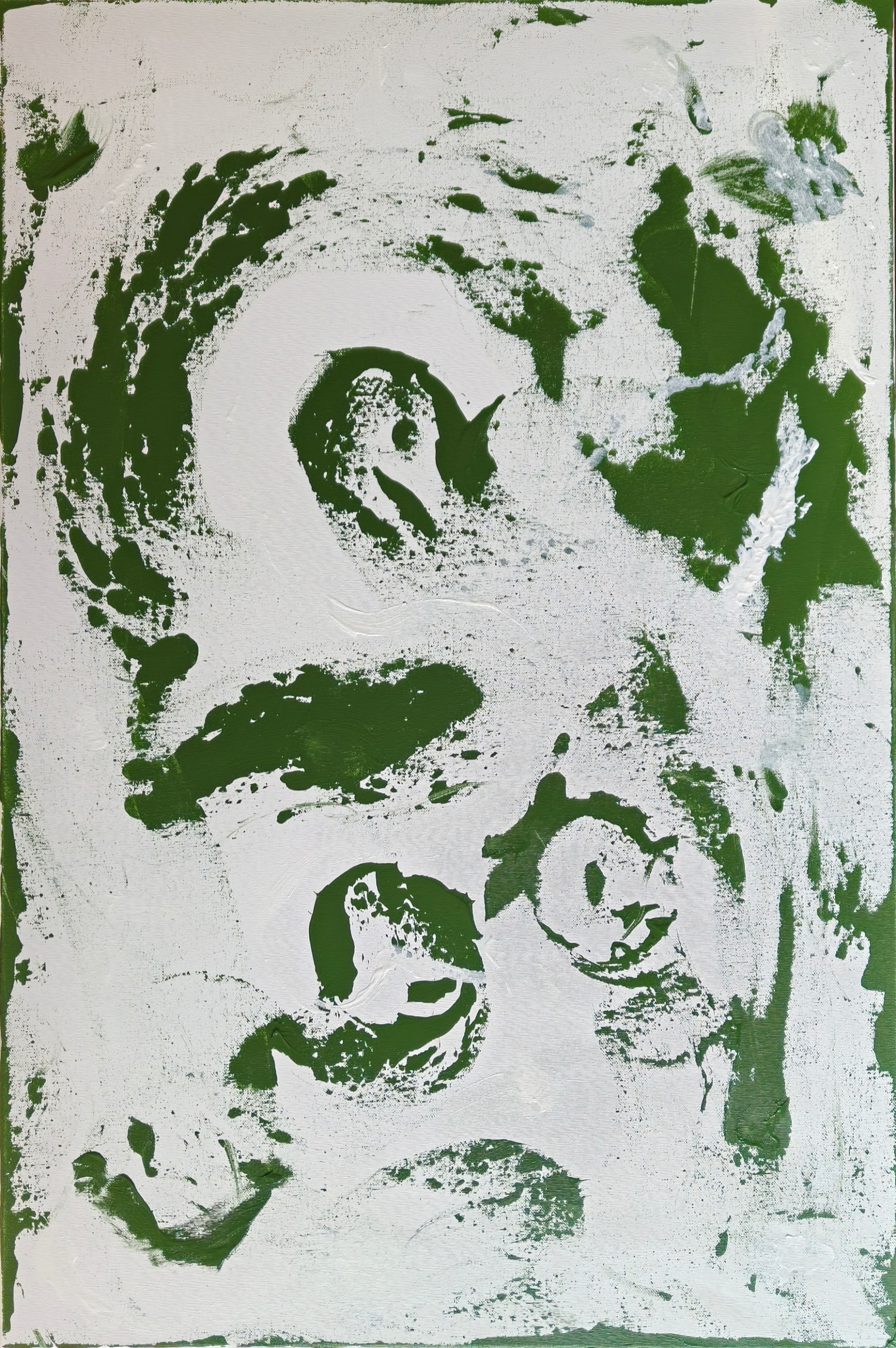
1. In "The Utopia Series Shanghai 002," a physical composition of gestural marks and thick pigment layers is translated into a digital pixelated matrix via high-resolution scanning. What is conceptually lost or found
when the thick, physical topography of paint on canvas is flattened into a glowing screen interface?
As I have previously discussed,, when the topographical complexity of The Utopia Series Shanghai 002 is compressed into a luminous screen, it is inevitable that the depth of the viewing experience is diminished. The imagery composed of digital matrices loses the phenomenal richness inherent in physical artworks—such as the viscosity of the paint, the sense of thick impasto, and the way shadows converge and disperse within the fissures of the pigment. Yet what is "lost" is counterbalanced by what is "found." Digitization transforms a singular, location-bound object into a fluid, replicable entity—a presence defined by velocity and reach rather than mass. The painting evolves from a static artifact into a migratory image, a digital skin inhabiting infinite screens. This does not negate the original’s value but adds conceptual elasticity: meaning is not fixed within the object but flows through its manifestations.
1. In "The Utopia Series Shanghai 002," a physical composition of gestural marks and thick pigment layers is translated into a digital pixelated matrix via high-resolution scanning. What is conceptually lost or found
when the thick, physical topography of paint on canvas is flattened into a glowing screen interface?
As I have previously discussed,, when the topographical complexity of The Utopia Series Shanghai 002 is compressed into a luminous screen, it is inevitable that the depth of the viewing experience is diminished. The imagery composed of digital matrices loses the phenomenal richness inherent in physical artworks—such as the viscosity of the paint, the sense of thick impasto, and the way shadows converge and disperse within the fissures of the pigment. Yet what is "lost" is counterbalanced by what is "found." Digitization transforms a singular, location-bound object into a fluid, replicable entity—a presence defined by velocity and reach rather than mass. The painting evolves from a static artifact into a migratory image, a digital skin inhabiting infinite screens. This does not negate the original’s value but adds conceptual elasticity: meaning is not fixed within the object but flows through its manifestations.
2. You describe the scanned painting as functioning like a "digital skin" or a "porous membrane" where inner sensation meets external mediation.How do you feel the ecrã (the screen) reshapes the emotional
intimacy originally embedded in the density of your physical medium?
The screen acts as a tool that refracts, rather than reflects, the emotional density of the physical work. Intimacy in the studio arises from proximity—leaning close, seeing pigment granularity, sensing the artist’s hand. The screen imposes a distance, altering the nature of this intimacy. Yet mediated intimacy is not inferior; it is different. A digital skin is porous—it allows the viewer’s psychological projections to seep through. Viewers may zoom into a single brushstroke that resonates personally, deepening intimacy through a private encounter. It transforms a communal gallery experience into a one-on-one dialogue between the viewer’s psyche and the digitized image. The emotional core remains, but its reception becomes more subjective.
intimacy originally embedded in the density of your physical medium?
The screen acts as a tool that refracts, rather than reflects, the emotional density of the physical work. Intimacy in the studio arises from proximity—leaning close, seeing pigment granularity, sensing the artist’s hand. The screen imposes a distance, altering the nature of this intimacy. Yet mediated intimacy is not inferior; it is different. A digital skin is porous—it allows the viewer’s psychological projections to seep through. Viewers may zoom into a single brushstroke that resonates personally, deepening intimacy through a private encounter. It transforms a communal gallery experience into a one-on-one dialogue between the viewer’s psyche and the digitized image. The emotional core remains, but its reception becomes more subjective.
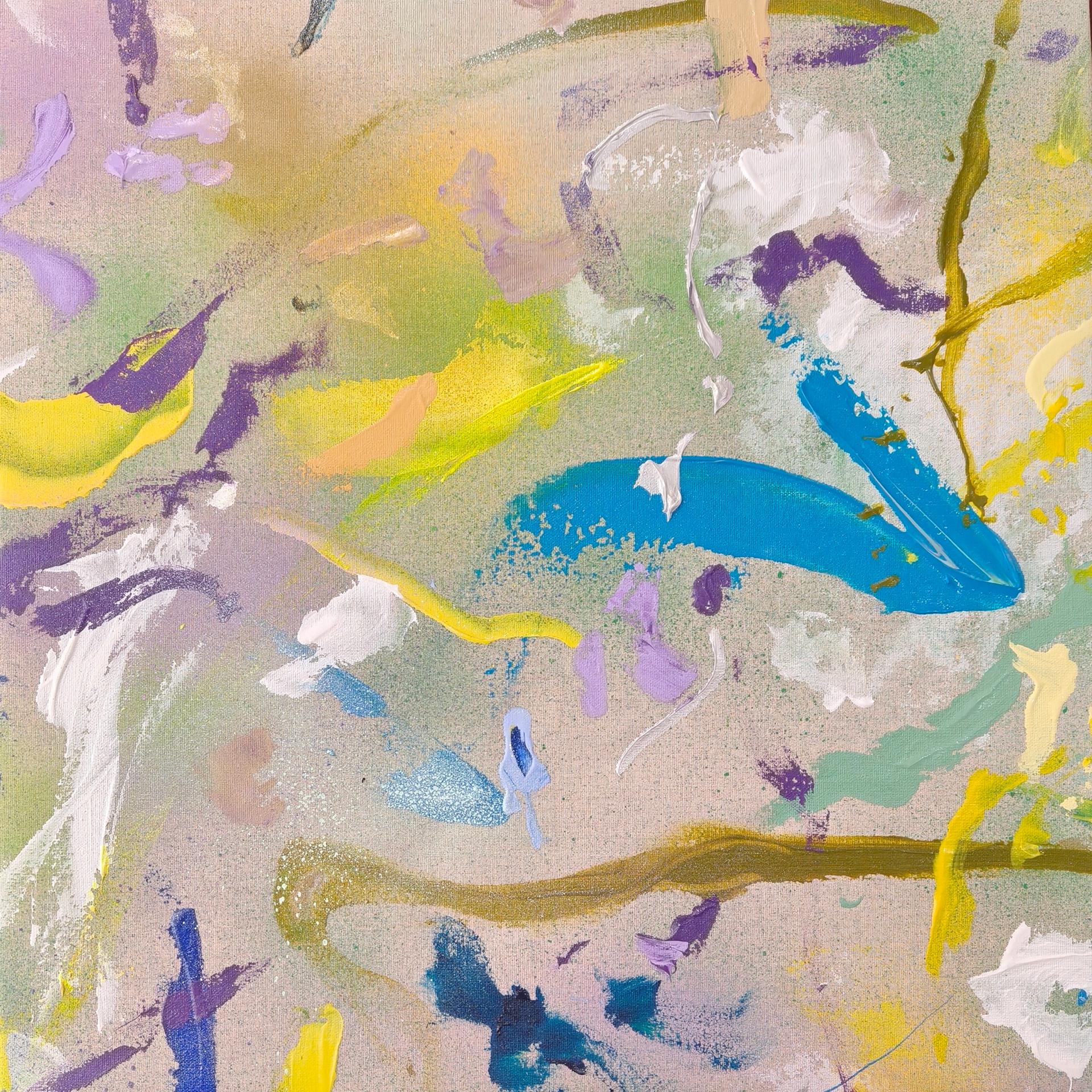
3. For the artwork "Awareness," you mention that stripping the image of its physical weight causes it to float within virtual architecture, making it accessible only through a cursor's proxy. Does the cursor act as an extension of our biological body, or does it heighten our alienation from the artwork?
The cursor occupies a liminal space between extension and alienation. On one hand, it functions as a digital prosthetic device—an extension of our biological intent. Just as a brush extends the artist’s neural activities onto the canvas, the cursor extends the viewer’s agency into the digital realm. On the other hand, interacting via glass lacks resistive feedback, which can feel alienating. Ultimately, the cursor embodies both tendencies. It is a navigation tool that simultaneously connects and distances. In Awareness, this duality mirrors consciousness itself—constantly reaching out to connect, yet forever aware of its own separation.
4. In your description of "Awareness," you observe that the dense application of paint gives way to binary code, turning the act of painting into pure data circulation. If a painting becomes code, does it lose its original artistic soul, or does it gain an expanded digital immortality?
The artistic soul is not confined to the material substrate but resides in the transmission of affect and meaning. When a painting becomes code, it undergoes metamorphosis, not loss. The "soul" is recognised and sustained through perception, as it ignites the sparks of recognition in the audience. As code, the work achieves digital immortality: it can be duplicated without degradation and archived indefinitely. Algorithms may analyze patterns invisible to the human eye; VR may let viewers inhabit the painting’s space. The soul persists not as a static essence trapped in matter, but as a dynamic force circulating through data networks, perpetually renewed by each act of viewing.
The artistic soul is not confined to the material substrate but resides in the transmission of affect and meaning. When a painting becomes code, it undergoes metamorphosis, not loss. The "soul" is recognised and sustained through perception, as it ignites the sparks of recognition in the audience. As code, the work achieves digital immortality: it can be duplicated without degradation and archived indefinitely. Algorithms may analyze patterns invisible to the human eye; VR may let viewers inhabit the painting’s space. The soul persists not as a static essence trapped in matter, but as a dynamic force circulating through data networks, perpetually renewed by each act of viewing.
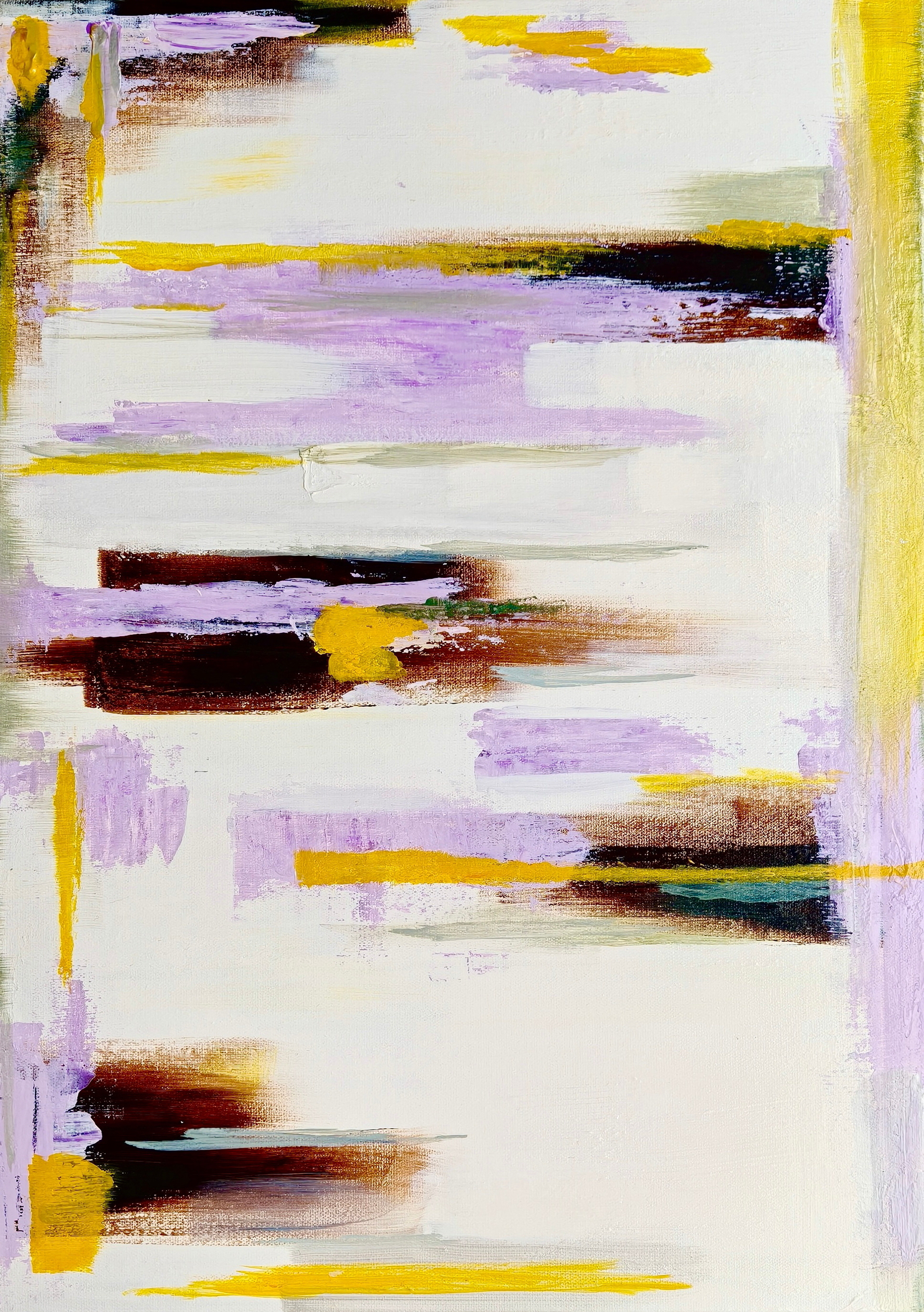
5. The third piece, "Architecture of the Self," utilizes linear striations across a bleached field, which you
compare to fading mnemonic residues or afterimages of thought. How do you think the medium of abstract expressionism is uniquely suited to visualize the volatile, fluid processes of human memory?
compare to fading mnemonic residues or afterimages of thought. How do you think the medium of abstract expressionism is uniquely suited to visualize the volatile, fluid processes of human memory?
Human self-cognition is inherently fluid; every present state shifts, and improvised gestural marks naturally record these passing states. Yet in outward expression, we instinctively embellish—like wearing a mask. Abstract painting, tied to the immediate impulse of the moment, suffers less rational retouching and thus approaches the genuine flow of thought. In Architecture of the Self, the linear striations function as mnemonic traces, I employ healing-toned palettes to offer viewers serene perceptual space rather than criticism or aggression. Abstract expressionism, with its ambiguity and layering, becomes uniquely suited to visualize memory’s volatile architecture.
6. You state that within its digital incarnation, the self becomes uncontainable, "seeping through the screen" and being constantly reshaped by user interactions such as clicking, zooming, and scrolling. How does this shifting authority from the artist to the user alter the traditional boundary of an art object?
This shift dissolves the traditional boundaries of the art object. Conventionally, the artwork was a closed entity—the artist the speaker, the audience passive receivers. Digital interaction breaks this pattern: viewers actively reconfigure the work’s appearance through clicks, zooms, and scrolls. The details they focus on become new points of emphasis, allowing them to co-author the work’s meaning alongside the artist. Consequently, the artwork’s boundaries extend beyond the screen, reaching into the viewer’s gestures and interpretations. It is no longer a self-contained object, but a dynamic, relational event; in my opinion, this is the greatest challenge the digital age poses to the notion of artistic ownership.
INTERSECTION WITH THE THEME: "THE SELF AS INTERFACE"
1. Your paintings capture the precise moments where visceral, biological pathways and raw neural emotion are flattened into computational data. In your view, is the digital interface a barrier that traps human
consciousness, or a new canvas that expands it?
I firmly believe the digital interface is a new canvas that expands consciousness. A barrier implies obstruction, yet the digital interface facilitates previously impossible connections—linking disparate minds, geographies, and disciplines. My practice exemplifies this: by translating neural processes into digital formats, I render the invisible activities of the mind accessible. The digital interface provides a substrate for externalization and exchange. However, expansion comes with responsibility. Algorithms prioritize certain engagements; screens flatten sensory input. The goal is to use the interface as a tool for extending perceptual and empathetic capacities—not a cage for manipulating the self, but a frontier through which consciousness can project, interact, and evolve.
1. Your paintings capture the precise moments where visceral, biological pathways and raw neural emotion are flattened into computational data. In your view, is the digital interface a barrier that traps human
consciousness, or a new canvas that expands it?
I firmly believe the digital interface is a new canvas that expands consciousness. A barrier implies obstruction, yet the digital interface facilitates previously impossible connections—linking disparate minds, geographies, and disciplines. My practice exemplifies this: by translating neural processes into digital formats, I render the invisible activities of the mind accessible. The digital interface provides a substrate for externalization and exchange. However, expansion comes with responsibility. Algorithms prioritize certain engagements; screens flatten sensory input. The goal is to use the interface as a tool for extending perceptual and empathetic capacities—not a cage for manipulating the self, but a frontier through which consciousness can project, interact, and evolve.
2. Your works translate highly analog, bodily expressions (the physical brushstroke as an extension of
physiology) into algorithmic data traces. How does this tension between human flesh and screen logic manifest when presented within the post-digital space of Galeria 5ª ao Sul?
physiology) into algorithmic data traces. How does this tension between human flesh and screen logic manifest when presented within the post-digital space of Galeria 5ª ao Sul?
This tension manifests as a productive friction—a dialogue between the artistic expression and the algorithmic. My brushstrokes carry residues of physical presence: micro-tremors of the hand, the pressure of breath, the trace of pigment responding to muscle memory. These are the intuitive analog signals representing physical transmission.
When the artistic expression of the signals are translated into algorithmic data—pixelated, compressed, rendered on screens—they undergo purification: the noise of the physical world is filtered, leaving a flattened trace. This proposal highlights the irreducible gap between body and machine, yet also reveals their interdependence. The flesh inspires the screen logic; the algorithm disseminates the information that the flesh conveys. The tension is not a conflict to be resolved but a condition to be explored—a reminder that even in technologically mediated experiences, the presence of the physical existence still lingers indelibly.
When the artistic expression of the signals are translated into algorithmic data—pixelated, compressed, rendered on screens—they undergo purification: the noise of the physical world is filtered, leaving a flattened trace. This proposal highlights the irreducible gap between body and machine, yet also reveals their interdependence. The flesh inspires the screen logic; the algorithm disseminates the information that the flesh conveys. The tension is not a conflict to be resolved but a condition to be explored—a reminder that even in technologically mediated experiences, the presence of the physical existence still lingers indelibly.
3. Through your solo exhibitions and creative brand work, you seek to reshape public narratives around
human cognition and space. What overarching dialogue or realization do you hope a visitor triggers when navigating your digital skins within this hybrid exhibition?
I hope my works will inspire reflection on two key aspects within this exhibition. First, the boundary between science and art, reason and intuition, is not as starkly binary or impenetrable as the common perception suggests; by utilizing abstract painting to apply and disseminate cognitive neuroscience, I aim to dismantle the notion that "scientific knowledge must be obscure and difficult to understand." In my practice, artistic creation serves as a bridge, transforming complex brain science into embodied experiences. Second, I hope my artworks can also function as an undefined language that circulates across different contexts, enabling viewers to better experience the works while projecting themselves onto specific messages embedded within them. I hope this exhibition will prompt people to reflect upon the self in the digital age: when viewers browse the 'digital skin,' the exhibited works act as mirrors. I want them to realize that identity is not a fixed essence, but rather a dynamic interface—constantly reshaped through interactions with technology, the environment, and other beings. The self is not a static entity confined behind a screen; rather, it is fluid, capable of extending consciousness across digital mediums.